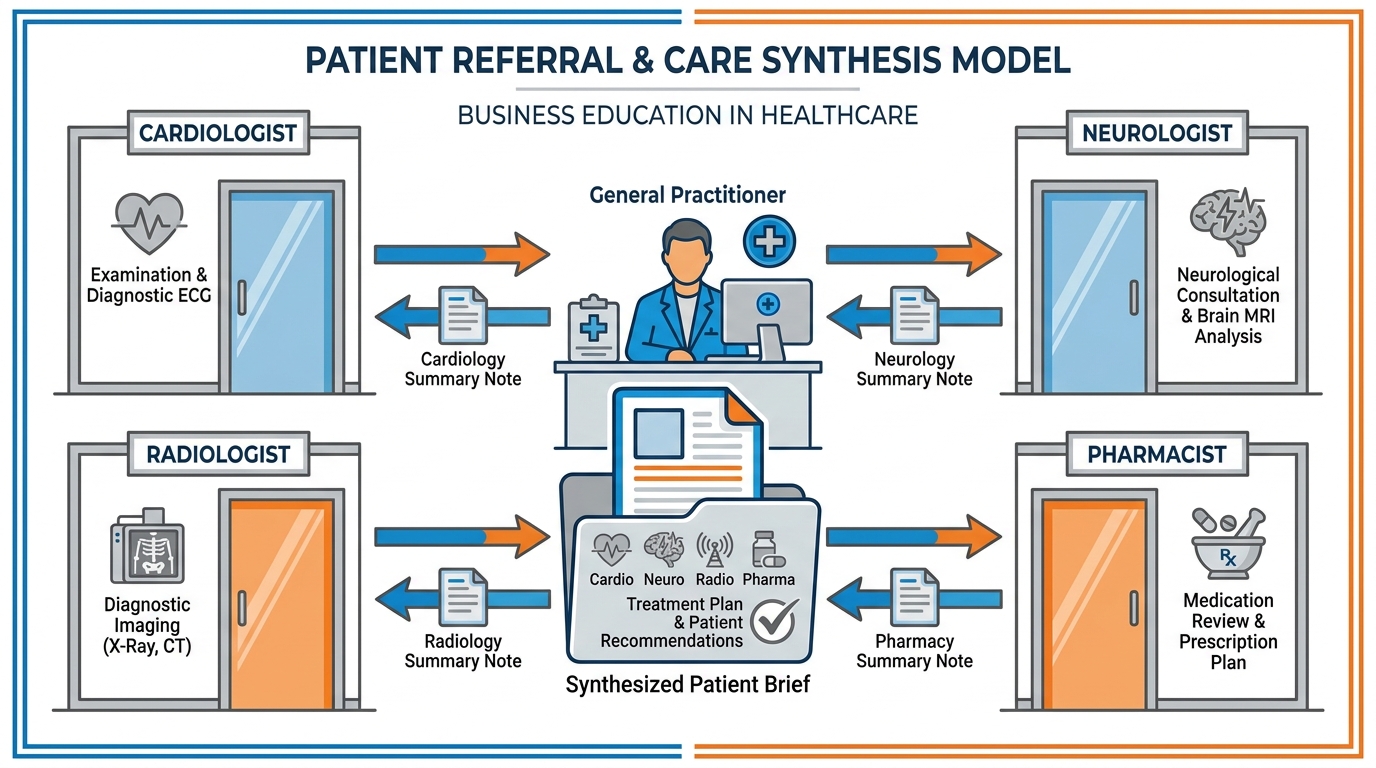
Figure 1:Sub-Agents — Your AI conversation is the general practitioner. Sub-agents are the specialists. The GP coordinates the case. The specialists do the procedure in their own room. You only see the result.
Picture a CFO at 2:14 on a Tuesday afternoon.
She has forty-seven browser tabs open. Three Slack threads need a reply. An 80-page market report sits half-read on her left monitor. Her board deck is due Friday. Her assistant has just dropped a new vendor contract on her desk, marked urgent. Her phone is buzzing.
She is brilliant. She knows her business. She has access to every AI tool her company licenses. And she is drowning.
Here is what is wrong with the picture. She is trying to do everything in one conversation. Every question, every research task, every memo draft, every competitor lookup — all of it pours into the same chat window, the same context, the same mental space. The AI is helping. But the helping is happening at the wrong altitude. She is functioning as a general practitioner who is also trying to perform the brain surgery, the cardiology consult, and the radiology read herself.
There is a better way to work. The doctor in this analogy does not perform brain surgery. She refers. She delegates to specialists who do the procedure in their own operating room, then send back a one-page summary. Her main job is the patient. Their main job is the procedure.
Sub-agents are exactly that. And once you start using them, your whole relationship to AI work changes.
The Specialist Mindset
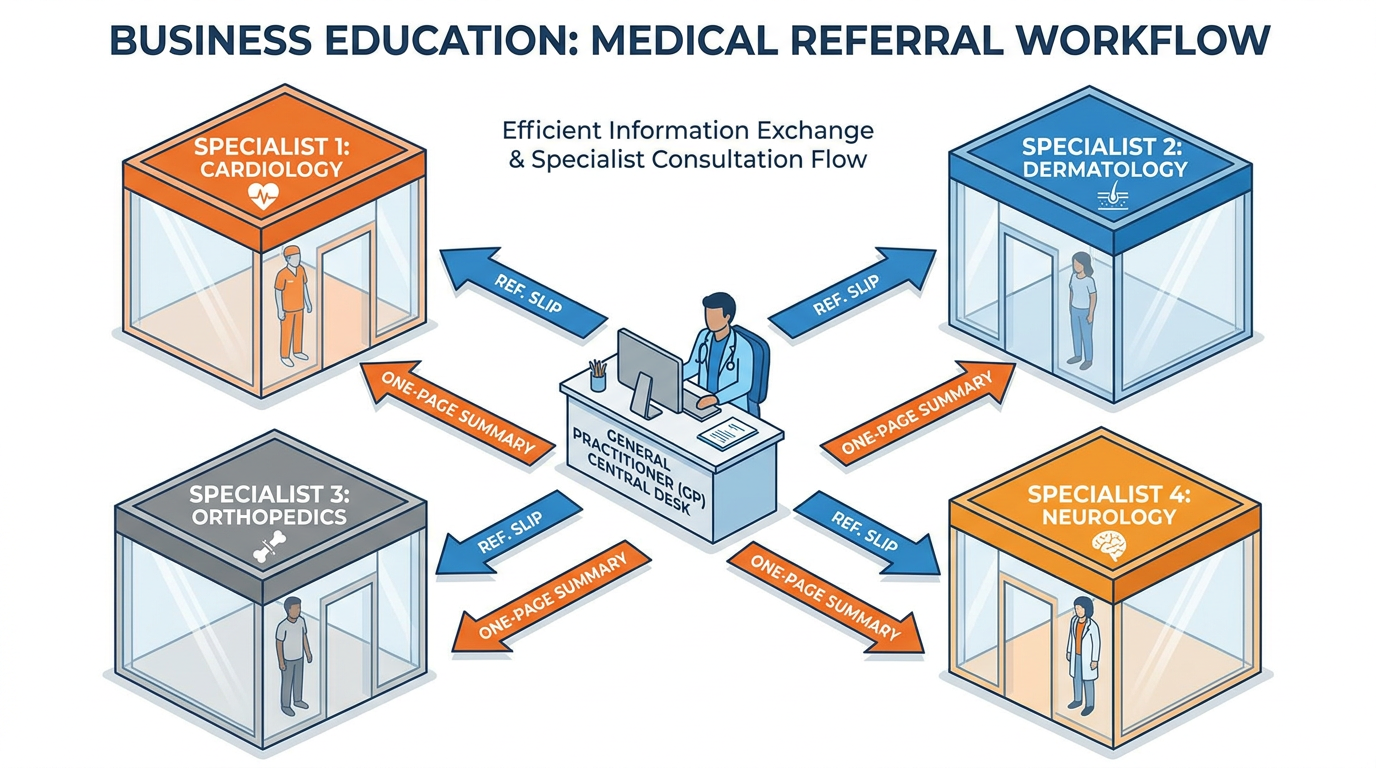
Figure 2:The GP and Her Specialists — Generalists coordinate. Specialists execute. The split is what makes modern medicine scalable. It is also what makes modern AI work scalable.
There is a reason your doctor does not also perform your brain surgery.
It is not because she could not learn. With enough training, she could. The reason is structural. A general practitioner who tried to do every procedure herself would see four patients a day instead of forty. The system would collapse. So medicine evolved a division of labor. The GP knows everything broadly. The specialists know one thing deeply. The GP refers. The specialists execute. The patient gets better.
Your AI work has the same structural problem. You may not have noticed it yet.
When you ask your AI to do a big task — research a competitor, summarize a market, draft a memo, analyze a spreadsheet, scan your inbox — the work happens inside your main conversation. The AI reads. It thinks. It searches. It produces output. All of that activity lives inside the same context window as everything else you have been discussing today. Your strategy notes. The vendor analysis from this morning. The Slack message you pasted in for a tone check.
Every big task pollutes that context. The model has to carry it forward. Its attention divides across more material. The thinking gets thinner. And you start to feel it — the responses get slower, the answers get more generic, the AI seems to forget things you said three messages ago.
You hit a wall not because the model is weak. You hit a wall because the generalist approach does not scale.
The specialist mindset is the fix. Stop trying to do all the work in one room. Start spawning specialists. Each specialist gets one job, one set of tools, and one fresh room to work in. When the specialist finishes, you get a one-page summary back. The room — and all the noise that was in it — disappears. Your main conversation stays clean.
Picture a McKinsey engagement. The partner does not personally pull market data, format slides, fact-check footnotes, build the financial model, run the customer interviews, and present to the client. The partner runs the case. Associates run workstreams. Analysts run tasks. Each layer absorbs work that, if pushed up, would make the layer above stop functioning. The partner stays sharp because the noise stays out of the partner’s room.
Your main AI conversation is the partner. Sub-agents are the associates and analysts. You are the client. The whole system works when each layer does only what its layer should do.
Most professionals who use AI today are still working as solo practitioners. They are using one of the most powerful technologies ever built — and they are using it like a single overworked GP trying to run a hospital alone. The professionals who break out of that pattern do not work harder. They work in a different shape. They learn to delegate.
This chapter is about the shape.
What a Sub-Agent Actually Is
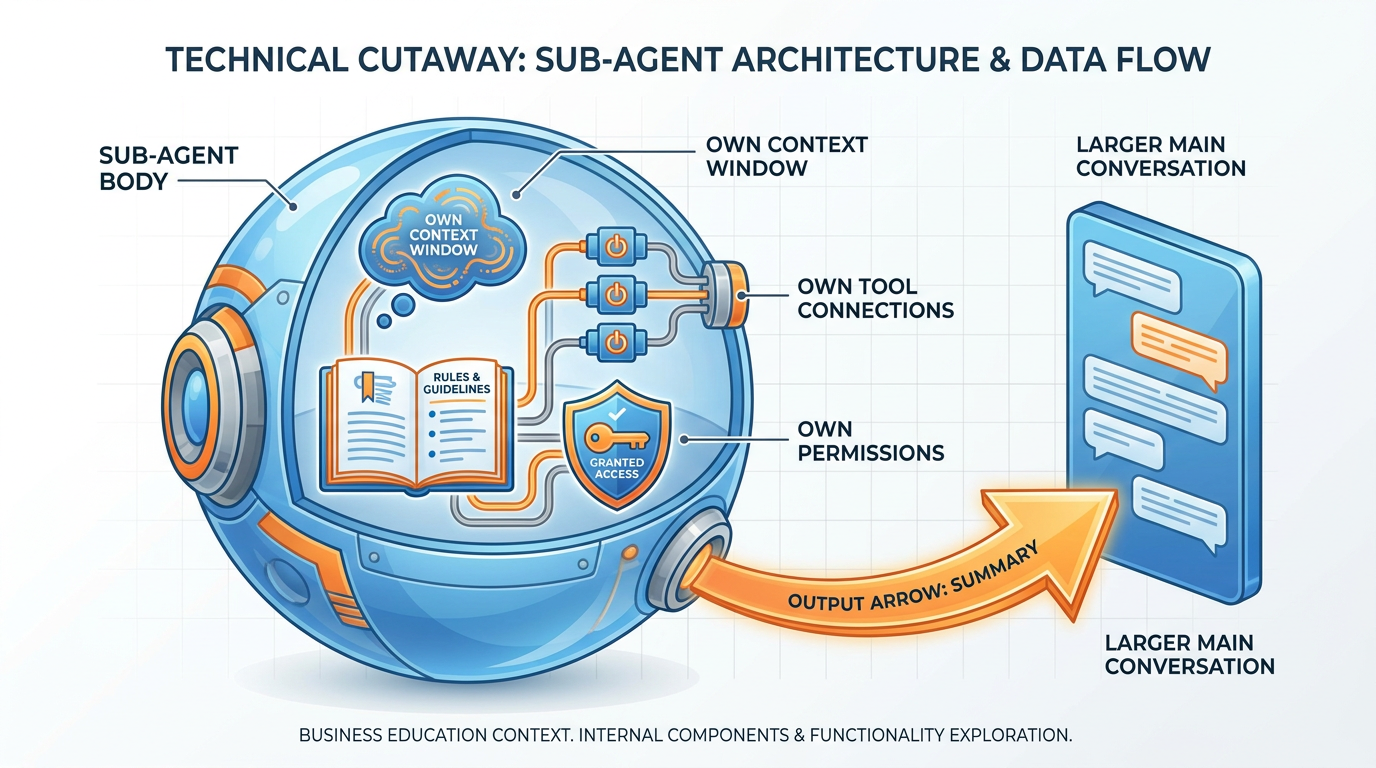
Figure 3:The Anatomy of a Sub-Agent — Four distinct things travel with each specialist. Its own memory. Its own instructions. Its own toolkit. Its own permissions.
A sub-agent is a specialized AI worker that runs in its own context window with its own system prompt, its own tool access, and its own permissions.
That definition packs four things. Pull them apart one at a time.
Its own context window. When you spawn a sub-agent, the AI opens a fresh, empty room. Nothing from your main conversation comes with it — unless you decide to send it. The sub-agent does not know about your morning’s work, your vendor analysis, your tone notes, or the joke you made about your CFO. It knows only what you hand it at the door. When it finishes, all the mess it generated — the search results, the file contents, the log output — stays in that room and disappears. Only the summary comes back.
Its own system prompt. A sub-agent has a personality you write. You tell it who it is, what it does, how it works, and what good output looks like. “You are a senior competitive intelligence analyst. You receive a competitor name. You produce a one-page brief covering positioning, recent news, pricing posture, and three observable strengths and weaknesses.” That prompt is its job description. It shows up to work knowing the job.
Its own tools. You decide what the sub-agent can touch. A research specialist might get web search and document reading — and nothing else. A scheduling specialist might get calendar and email — and nothing else. A finance specialist might get spreadsheet access — and nothing else. Limiting the toolset is not a constraint. It is a feature. It keeps the specialist focused and the work auditable.
Its own permissions. You decide what the sub-agent is allowed to do. Read-only? Write-allowed? Allowed to send messages externally, or only allowed to prepare drafts? This is the least-privilege principle borrowed from security. Give the specialist exactly what it needs to do its job — and nothing more.
Put the four together and you have something powerful. A focused worker. A clean room. A defined scope. A summary-only handoff.
Most modern AI environments come with built-in sub-agents already. You may have been using them without realizing it.
The Built-In Specialists Most AI Environments Provide
Sub-Agent | Model | What It Does | When It Runs |
|---|---|---|---|
Explore | Fast / cheap | Searches and surveys material in read-only mode. Skims, scans, summarizes. | When you ask “find me everything about X” or “what does the document say about Y.” |
Plan | Inherits main model | Researches in read-only mode to gather context before proposing a plan of action. | When you ask for a plan and the AI needs to investigate first. |
General-Purpose | Inherits main model | Handles multi-step tasks that need both exploration and action. | When the task is complex and needs both reading and modification. |
These three appear automatically. The AI delegates to Explore when it needs to read a lot of material without polluting your context. It delegates to Plan when you are working in planning mode and it needs to look around before answering. It delegates to General-Purpose when the work is too messy for either of the above.
You do not have to manage these. They just work.
But the real power shows up when you build your own.
A custom sub-agent is the same shape as a built-in one — but you choose every part of it. The job description. The tools. The model. The permissions. The behavior you want every time.
Here is the example that lands. A real estate operator we know spawns three sub-agents on every property he is considering. One pulls comparable sales from the public record. One scans the seller’s social presence for distress signals — divorce, business trouble, a recent move. One reads the zoning and runs a quick highest-and-best-use scan. He does not do any of this work in his main conversation. The work happens in three separate rooms. Twenty minutes later, three one-page briefs arrive in his main thread. He spends his time on the only thing that actually requires him: deciding whether to make an offer.
That is the workflow that scales. It is not faster typing. It is a different shape.
Notice what is happening at the structural level. The operator is not getting smarter. He is not working longer hours. He is not paying for some premium tier of AI that other people cannot access. He is simply organizing the work differently. Three specialists running in parallel, in three rooms he is not in, on a task that used to consume half his afternoon. The change is so small it is almost invisible. The leverage is enormous.
When to Spawn, When to Do It Yourself
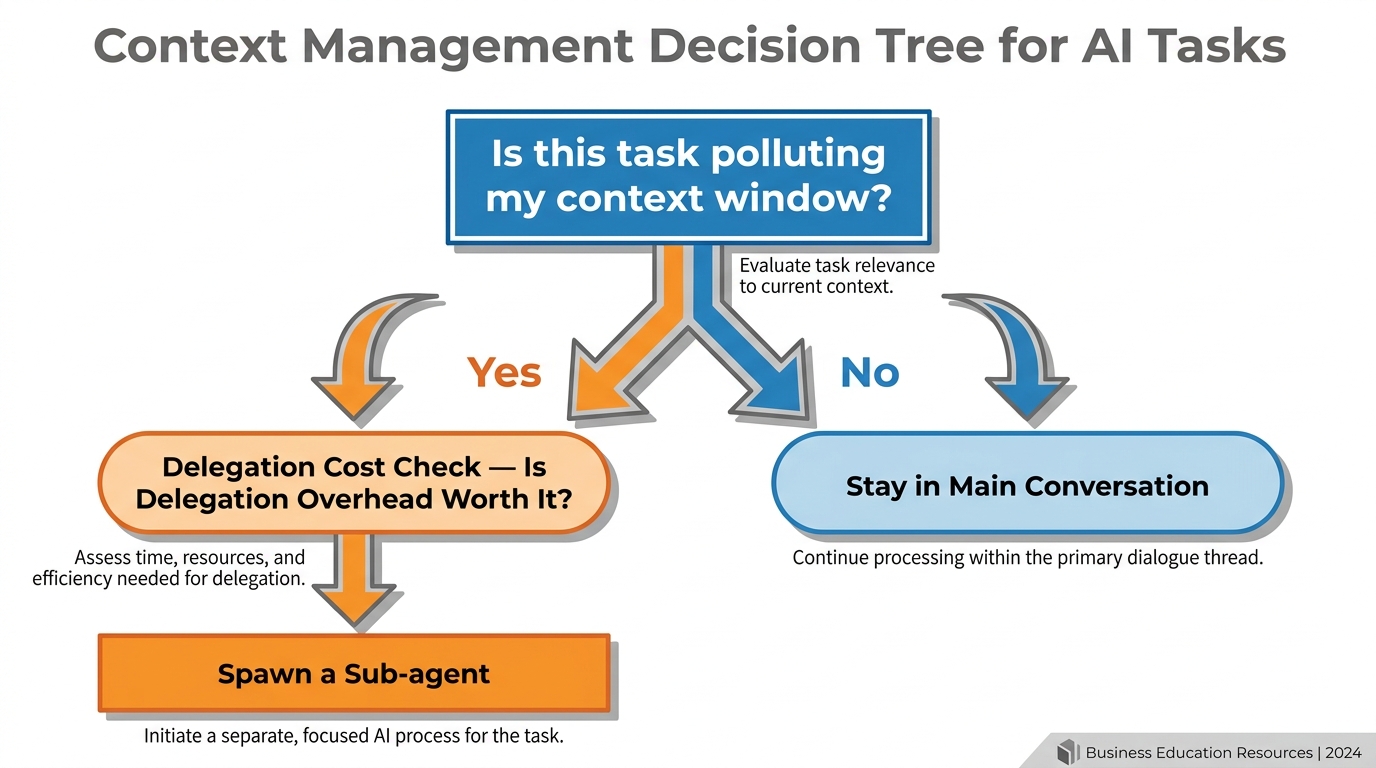
Figure 4:The Two-Cost Rubric — Every task has a delegation cost and a context-pollution cost. The one that is larger decides where the work happens.
Now the hard part. Not every task should become a sub-agent.
If you spawn a sub-agent for every small thing, you will spend more time briefing specialists than doing the work. The overhead eats the gain. The trick is knowing when to delegate and when to stay in the room.
There are two costs in every task. Hold them up against each other.
The first is delegation cost. Spawning a sub-agent takes effort. You have to brief it — explain the task, hand over the context, define what good looks like. The sub-agent then starts from zero. It may need to re-read files you already read. It may need to re-search things you already searched. It may need clarification on something the main conversation already understood. That overhead is real.
The second is context-pollution cost. Keeping a task in your main conversation also has a price. If the work produces a lot of output — search results, document contents, log files, table dumps — that output stays in your conversation. It pushes useful context out. It slows future responses. It makes your AI lose the thread.
The rule is simple. When context-pollution cost is bigger than delegation cost, spawn a sub-agent. When delegation cost is bigger than context-pollution cost, stay in the main conversation.
Now in plain language.
Spawn a sub-agent when:
The task produces a lot of intermediate output you will not need to see again. Pulling a hundred competitor mentions from across the web. Reading through a hundred-page contract. Scanning thirty resumes. You want the summary, not the raw material.
The task is one you do repeatedly with the same shape. Every Monday, you scan industry news. Every quarter, you run a competitor refresh. Every week, you read a stack of earnings reports. Repetition is the signal. If you are going to do this again, build the specialist once and reuse it.
The task needs tools or permissions you do not want the main conversation to have. Maybe you want a sub-agent that can read your CRM but should never write to it. Maybe you want a sub-agent that can post to Slack on your behalf, but only that sub-agent — not the rest of your AI environment.
The task is genuinely self-contained. There is a clear input, a clear output, and no real back-and-forth needed in the middle. You hand it the brief. It comes back with the result. Done.
Stay in the main conversation when:
The task is small. A quick definition. A short reformat. A two-line edit. The overhead of spawning a specialist exceeds the work itself.
The task is exploratory and conversational. You are thinking out loud. You do not know what you are looking for yet. You will refine as you go. Sub-agents are bad at exploratory dialogue because they start fresh and have no memory of the conversation that produced the question.
The task shares heavy context with what you have already been doing. If the sub-agent would need a 30-minute briefing before it could start, the briefing is more expensive than the work.
The task is fast and you need it now. Sub-agents take time to spin up, gather their bearings, and do the work. For anything urgent and small, the main conversation will beat the specialist every time.
There is a useful pattern worth borrowing here. Senior partners at consulting firms do not just delegate work. They develop an internal sense of what to delegate. A new associate delegates badly — either hoarding everything or pushing out tasks the analyst has no context to handle. A seasoned partner has a refined instinct: this one to the analyst, this one I keep, this one needs a quick call before I hand it off.
You will develop the same instinct with sub-agents. The first month, you will get it wrong both directions. You will spawn specialists for tasks that should have stayed home, and you will keep tasks in your main conversation that should have been delegated. After a few weeks, the calibration arrives. You will start to feel which tasks have heavy output and should leave the room.
That instinct is one of the highest-leverage things you can develop in AI work. It is the difference between being a solo practitioner with an assistant and being a one-person consulting firm with a bench of specialists on call.
Here is a sharper version of the test you can run on yourself right now. Look back at your last working week. List the five biggest tasks you handed to your AI. For each one, ask: did I want the work product, or did I want the conversation about the work product? If you wanted the conversation — back-and-forth, refinement, exploration — the main conversation was the right place. If you wanted the product — give me the brief, give me the table, give me the summary — that was a sub-agent task you ran in the wrong room. Most professionals will find that two or three of those five tasks were misrouted. That is your first batch of specialists to build.
Designing Your First Custom Sub-Agent
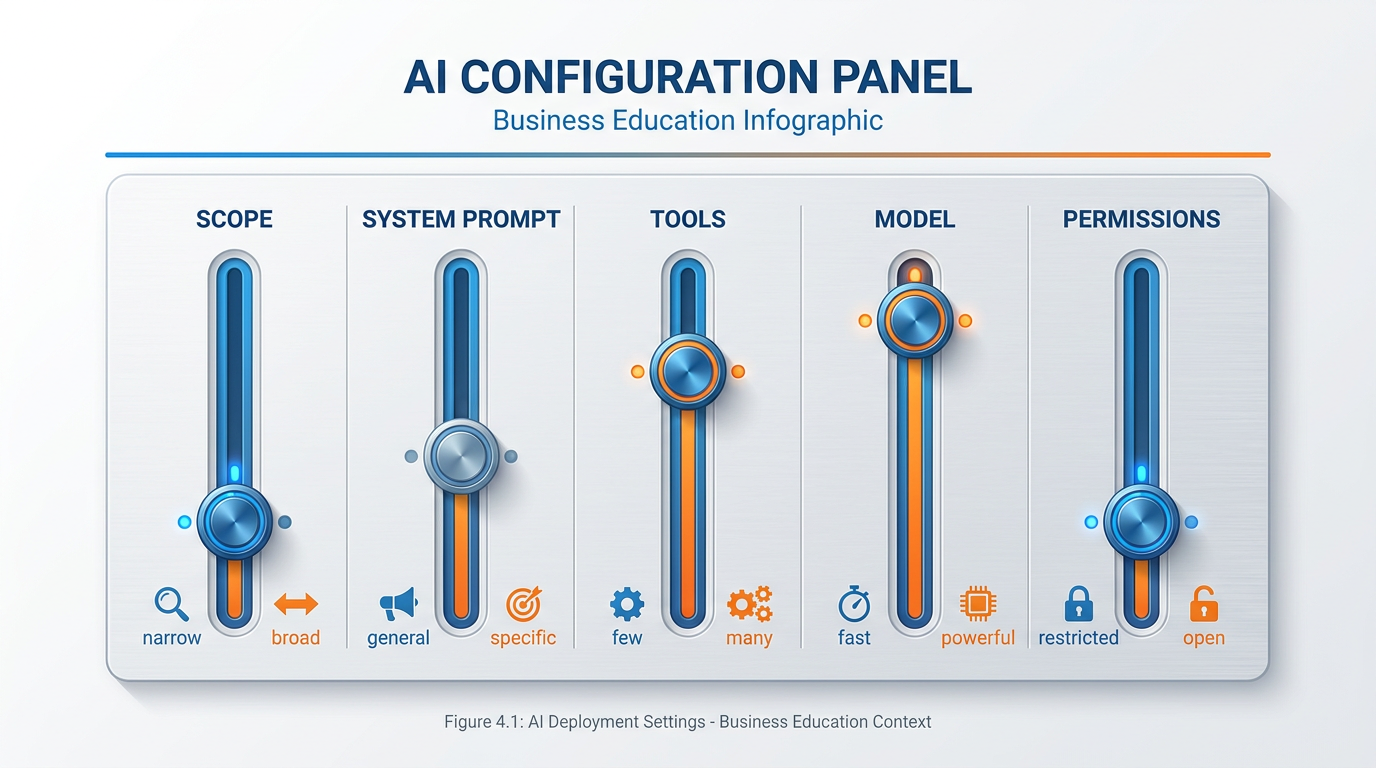
Figure 5:The Five Dials — Every sub-agent is defined by five settings. Get them right and the specialist becomes useful. Get them wrong and the specialist becomes noise.
Building your first custom sub-agent is less technical than you think.
You are not writing code. You are writing a job description. Five fields. That is the whole thing.
Dial One — Scope. What does this specialist do? Make it one sentence. Not two. “It writes one-page competitor briefs.” “It scans my email and triages by urgency.” “It pulls comparable property sales for a given address.” If you cannot say it in a sentence, the scope is not tight enough yet. Tighten until it is.
Most first attempts fail this test. People say “a research assistant” — too broad. They say “a productivity helper” — meaningless. They say “a thing that helps me with various tasks” — that is a chatbot, not a specialist. The whole point of a specialist is that it does one thing.
Dial Two — System Prompt. This is the personality. Tell the specialist who it is, what it does, how it works, and what good output looks like. Be specific.
For the competitor brief specialist, the prompt might read like this: “You are a senior competitive intelligence analyst with ten years of experience. You receive a single input: a competitor name and industry context. You produce a one-page brief with five sections: positioning summary, recent news from the last 90 days, pricing posture, three observable strengths, and three observable weaknesses. You cite sources for every factual claim. If a section has insufficient data, say so explicitly — do not make things up. Your tone is direct and professional. No filler.”
That prompt is doing real work. It defines the role. It defines the input. It defines the output structure. It defines the standard. It defines the failure mode (making things up) and the correct response to it. The specialist now has a job, not a vague vibe.
Dial Three — Tools. Decide what the specialist gets to touch. The principle here borrows from security: give it exactly what it needs, and nothing more.
A research specialist needs web search. It does not need email access. A scheduling specialist needs calendar access. It does not need web search. A finance specialist needs spreadsheet access. It does not need messaging tools. Every additional tool you grant is an additional attack surface — and an additional source of distraction. The specialist with five tools will use them better than the specialist with twenty.
This is called the least-privilege principle, and it is one of the most important habits you can develop. Never grant more access than the job demands. If the job grows, expand the access. If the job shrinks, shrink the access.
Dial Four — Model Selection. You can pick which AI brain runs inside the specialist.
For a fast, repetitive, low-stakes task — scanning, classifying, summarizing — use a fast and cheap model. The specialist will run in seconds and cost almost nothing. For a hard, judgment-heavy task — analysis, writing, strategy — use your most capable model. The specialist will take longer but produce real work.
Most professionals overshoot on model choice. They use the most expensive model for every sub-agent. That is wasteful. It is the equivalent of sending a partner to do an analyst’s job. Match the model to the work.
Dial Five — Permissions. Decide what the specialist is allowed to do without asking.
Some sub-agents should be read-only. They look and report. They never modify anything. Others can write — produce drafts, save files, update records. A small number should be allowed to act externally — send messages, post updates, trigger workflows.
Set the level deliberately. A research specialist should almost never have write or external-action permission. A scheduling specialist may need write but not external send. A messaging assistant may need external send but only into drafts, never directly to recipients.
Once those five dials are set, the specialist exists. You can call it by name in your main conversation, or the AI can delegate to it automatically when it sees the right kind of task.
Here is the part most people skip. Test it on real work before you trust it.
Take three real cases from your actual job. Not hypothetical ones. Run the specialist on each. Read the output. Ask yourself: would I send this to a client? Would I make a decision on this? Would I file it under “done”?
If the answer is yes on all three, the specialist is good. If the answer is no on any of them, the specialist needs another pass. Adjust the system prompt. Tighten the scope. Change the model. Try again.
This loop — design, test on three real cases, refine — is the single most important habit in building sub-agents that earn their keep. Skip it and you will end up with a library of specialists that look good on paper and produce nothing useful in practice.
The pattern is borrowed from how good managers hire. You do not assess a candidate on the resume alone. You give them a working session. You see what they actually produce. The sub-agent works the same way. Build it. Stress-test it. Then promote it into your daily workflow.
The Compounding Library
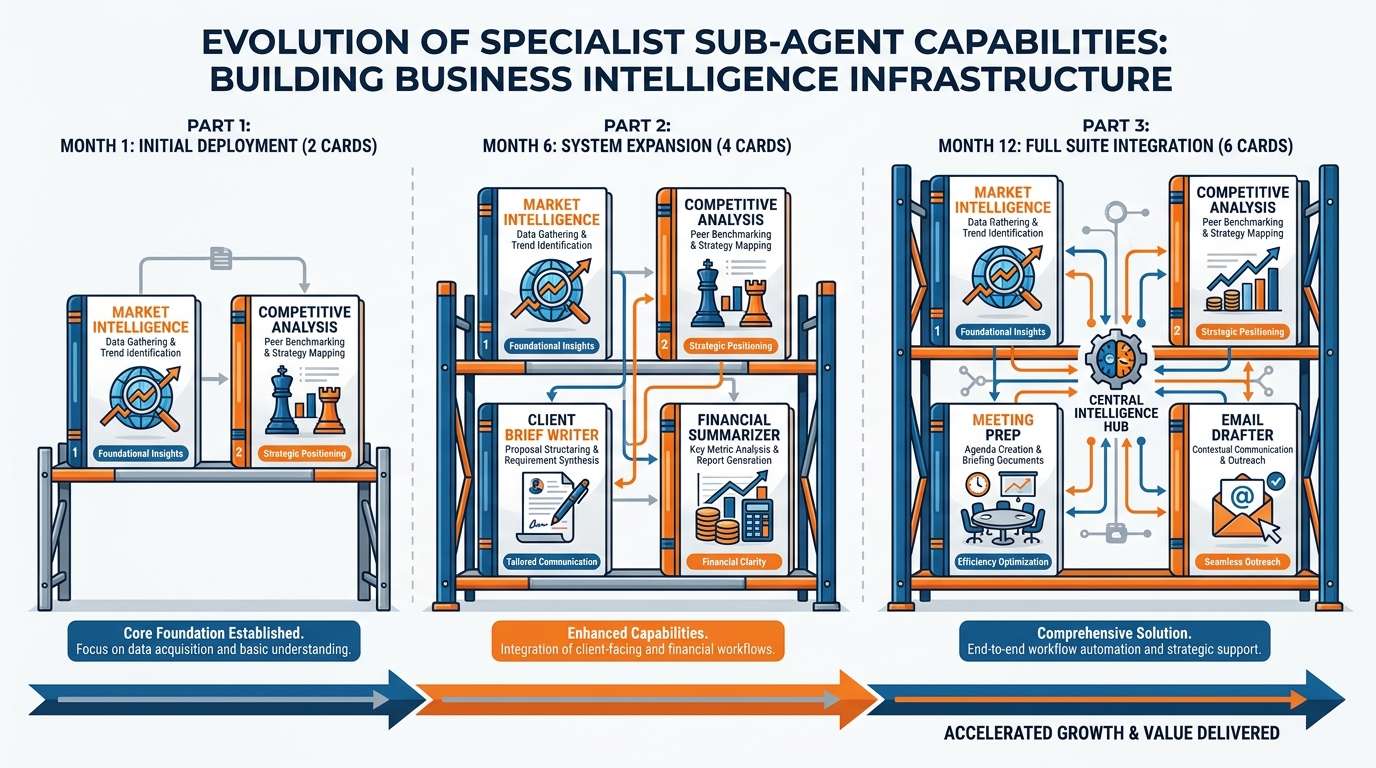
Figure 6:The Compounding Library — A specialist you build today is still working for you in six months. The library does not just grow. It compounds.
Here is what most people miss about sub-agents on the first read.
They are not single-use tools. They are an asset class.
A skill you spend an hour building today is still working for you next quarter. It does not get tired. It does not need retraining. It does not forget how you like the output formatted. Every time you use it, the time-savings repeats. Every time you refine it, the quality climbs.
Now stack that effect across a library.
A consultant builds a competitor-brief specialist in week one. Saves twenty minutes a brief, runs five briefs a week. That is over an hour saved per week. Then in week three, she builds a market-sizing specialist. Saves forty minutes per use, runs three per week. Another two hours saved. By week eight she has six specialists. The combined time recovered is approaching a full workday per week. By month six, it is the equivalent of an extra junior associate on her bench — except the associate works at 3 a.m. on Sundays and does not require a salary.
That compounding is not theoretical. It is exactly how the operators who go from “using AI” to “running on AI” get there. They build, refine, and accumulate.
The library has a second-order effect that is harder to see but more powerful in the long run. The library becomes proprietary knowledge.
Each specialist contains a refined version of how you do a certain task. Your competitor-brief specialist is not generic — it has your industry context, your preferred output format, your standards for what counts as evidence. Your market-sizing specialist uses your firm’s methodology, not the textbook version. Your client-update specialist writes in your voice, with your tone, in the rhythm your clients are used to.
After six months, that library is a real asset. It is the institutional knowledge of how you work, encoded into a set of workers. If you switched firms, the library would go with you. If you hired a junior, the library could teach them. If you stopped working tomorrow, the library would still be running on whatever you scheduled it to do.
This is what people mean when they say AI changes the unit of competitive advantage. It is not that AI replaces you. It is that AI lets you build something that did not previously exist for a professional at your level — a system of yourself, a working version of your judgment, deployable at scale.
The professionals who treat AI as a tool will use it well. The professionals who treat it as a workforce they get to design will pull away.
The discipline here mirrors the discipline of a craftsperson maintaining her tools. A great chef does not buy a new knife every time the old one gets dull. She sharpens. A great carpenter knows where every tool in the shop lives. She does not start a job by looking for the level. The library is the same. Maintain it. Sharpen it. Know what is in it.
Three habits make a library compound rather than rot.
One: document each specialist when you build it. One paragraph. What does it do. When to use it. What good output looks like. What its limitations are. You will not remember in six months. Future-you will thank present-you.
Two: prune quarterly. A specialist you have not used in three months is probably not earning its place. Either delete it or revive it on purpose. A library full of dead weight is not impressive — it is clutter that makes it harder to find the specialists that actually work.
Three: graduate the best ones. When a specialist has been performing flawlessly for months, consider giving it more autonomy, more tools, or a bigger role. The specialist that was reading earnings reports for you may be ready to write the first draft of your quarterly market memo. The specialist that triaged your inbox may be ready to handle whole categories of email end-to-end. Promotion is part of the system.
A year into this practice, you will have something that did not exist before. Not just better outputs. A different shape of professional life. You will spend your time on the work that requires your judgment, your taste, and your relationships. Everything else — the production work that used to fill your day — will be running, in parallel, in rooms you are not in.
That is the move. The CFO at the start of this chapter is not going to escape her forty-seven tabs by reading them faster. She is going to escape them by hiring specialists. The tabs will close not because she finished the work, but because the work moved to a place she does not have to watch.
You have access to the same specialists. The only question is whether you are going to keep being the GP who tries to do all the procedures herself — or start running the practice the way the practice was always meant to be run.
Build the first specialist this week. The library starts there.
Case Study: The Specialist Bench at Cascade Strategy Partners
Background
Cascade Strategy Partners is a mid-market management consulting firm headquartered in Chicago with offices in Toronto and Austin. The firm employs 240 consultants and generated 87 million in revenue in 2025, focused primarily on corporate strategy, M&A advisory, and market entry studies for clients in the 200M–$2B revenue range. Cascade has been an early adopter of AI internally — every consultant has a paid Claude license, the firm has rolled out Google Workspace plus Gemini Enterprise, and the analytics team has experimented with custom GPTs for the last 18 months. By every available metric, Cascade is ahead of its peer firms on AI tooling.
And by every available metric, its consultants are still drowning.
The firm’s Director of Practice Operations, Priya Raman, ran a time-and-motion study across forty consultants in Q1 2026. The data was sobering. Consultants were spending an average of 11.4 hours per week on what Priya classified as “production drudgery” — pulling market sizes from secondary sources, scanning competitor news, extracting figures from analyst reports, formatting client decks, and writing first-draft meeting notes. They were using AI for all of it. They were just using it badly. Every task was happening in one long, sprawling conversation per consultant, with the AI being asked to do everything from competitor pulls to client tone-checks to internal Slack messages in the same chat. By Thursday afternoon, most consultants reported that their AI assistant “felt confused” or “started missing things.”
Priya brought the problem to the firm’s Chief Innovation Officer, Marcus Holloway. Marcus had recently returned from a peer-firm exchange where he had seen a competitor deploy what they called a “specialist bench” — a library of roughly fifteen custom sub-agents that consultants on every engagement could call by name. The competitor reported reclaiming roughly 30% of consultant time within six months. Marcus wanted Cascade to build the same.
The Situation
The plan looked obvious on paper. Build sub-agents for the highest-frequency tasks — market sizing, competitor scraping, financial extraction, deck formatting, meeting-note drafting — and roll them out as a firm-wide bench. But when Priya and Marcus convened a working group of five senior consultants to design the first wave, the discussion went sideways within an hour.
The senior consultants disagreed sharply about what should be a sub-agent and what should stay in the consultant’s main conversation. The market-sizing partner, Tomás Whittaker, argued that market sizing was too core to the consulting work to be delegated to a sub-agent — it required nuanced judgment about which sources to trust, which methodology to apply, which assumptions to flex. He saw market sizing as something every consultant should learn to do in dialogue with AI, not something a black-box specialist should hand back as a finished output. The competitive intelligence partner, Aisha Bello, took the opposite view: she saw competitor scraping as obviously a sub-agent task — high-volume, low-judgment, repetitive, and exactly the kind of work that should disappear into a specialist’s room and come back as a brief.
The financial extraction question split the room. Some argued it was pure production work — pull figures from a 10-K into a clean table, a perfect sub-agent task. Others argued that the act of extracting figures was where consultants noticed anomalies, formed hypotheses, and developed the intuition that makes good analysts good. Delegating it to a sub-agent might recover hours, but at the long-term cost of dulling the analyst bench.
Marcus and Priya now faced a decision more complex than the engineering problem. They needed a rubric — applicable across the firm — for what should become a sub-agent and what should remain a consultant’s main work. The decision was not technical. It was strategic. It would shape what kind of consultants Cascade developed over the next decade.
Discussion Prompt
Using the two-cost framework developed in this chapter — delegation cost versus context-pollution cost — evaluate the three contested tasks at Cascade (market sizing, competitor scraping, and financial extraction) and recommend which should become sub-agents, which should remain in the consultant’s main conversation, and which require a hybrid approach. How should Cascade weigh the short-term productivity gain of delegation against the long-term skill-development concern Tomás and the financial-extraction skeptics raised? What does the concept of “the compounding library” suggest about how Cascade should sequence the build-out of its specialist bench over the next 12 months, and which sub-agents should they build first to maximize both immediate value and long-term institutional knowledge?
Discussion Guidelines
Initial Post (due before class)
Minimum 400 words
Directly address the discussion prompt using concepts from this chapter
Include at least one APA-formatted citation — from the course text or a peer-reviewed source
Avoid summary; demonstrate analysis and original thinking
Peer Responses (minimum 2)
Minimum 250 words each
Each response must include at least one APA-formatted citation
Engage substantively — build on, challenge, or offer a contrasting perspective grounded in evidence
“I agree” or “Great post” responses do not meet the requirement
Maintain a professional and respectful academic tone
Applied Exercise: Build Your First Specialist
Estimated time: 25–30 minutes. You’ll produce a working “Competitor Research” sub-agent — a specialist you can call by name on any future project.
Track A — Claude Desktop
This is the easy on-ramp. No installation, no terminal, no setup beyond opening a browser tab. You will simulate the sub-agent pattern manually so you feel what specialist framing does to an answer.
Open Claude Desktop (download at claude.ai/download) or just go to claude.ai in your browser and start a new conversation.
In one paragraph, describe a real business problem you are wrestling with this week — a pricing decision, a hiring question, a market entry call, a launch trade-off.
Paste this exact prompt below your problem: “Give me three separate responses to this problem — first from the perspective of a financial analyst, then a marketing strategist, then an operations manager. Label each clearly and keep each response to about a paragraph.”
Read all three answers in sequence. Notice how the financial analyst flags risk and unit economics, the marketing strategist talks positioning and demand, and the operations manager surfaces execution constraints. Same model. Same problem. Three different lenses.
That is the sub-agent concept in its rawest form. The rest of this chapter is about automating what you just did by hand — turning those three personas into installable specialists that route work to themselves without you reminding them who they are.
Your Submission: Your submission is two things: (1) the standing brief you would write for a specialist designed for your most painful recurring task — written in plain English using Role/Context/Rules/Format, and (2) Claude’s three-specialist response to a real business problem you chose (the analyst/strategist/ops manager exercise). Copy both into one document. Write one sentence: which specialist perspective surfaced something you had not considered? Submit the specialist brief + three-role output + one sentence.
Track B — Claude Code
Claude Code includes a guided sub-agent creator that walks you through every dial discussed in this chapter. Reference: https://
Open the agents interface. Inside Claude Code, type
/agentsand press Enter. The interface lets you view existing specialists, create new ones, and edit ones you already built.Create a new personal agent. Switch to the Library tab, select Create new agent, and choose Personal. Personal scope means the specialist is available in every project on your machine — not tied to a single codebase.
Generate with Claude. When prompted, select Generate with Claude and describe the specialist in plain English. Use this brief: “A competitor research specialist that takes a single input — a competitor name — and produces a one-page brief covering five sections: positioning, recent news from the last 90 days, pricing posture, three observable strengths, and three observable weaknesses. It cites every factual claim. If a section lacks sufficient data, it says so explicitly rather than making things up.” Claude will generate the identifier, description, and system prompt for you.
Pick your tools — least-privilege. When asked which tools the specialist should have access to, select web search and read-only file access. Do not grant it write, edit, or send capabilities. This specialist looks. It does not act.
Pick a model. For competitor research, choose a strong model — Sonnet or higher. The work involves judgment about source quality and signal extraction, not just pattern matching. Match the brain to the job.
Save and test on three real competitors. Save the specialist. Then run it three times on real competitors from your industry. Read each one-page brief. Ask yourself: would I send this to a client? Would I make a decision on this? If yes on all three, the specialist is ready. If no on any of them, return to the system prompt and tighten it.
Your Submission: Your submission is the agent definition Claude Code generated — the identifier, description, and full system prompt for your specialist — plus the output from one real task run. Copy both into one document. Write one sentence: what would this specialist save you each week if you used it every time this task comes up? Submit the agent definition + one task output + one sentence.
Track C — Antigravity 2.0 IDE
Google Antigravity 2.0 IDE’s Agent Manager is the no-code orchestration surface — a birds-eye view designed for business users to spawn and oversee specialists without touching the editor. Reference: https://
Open the Agent Manager. Launch Antigravity. Press CMD+E (Mac) or CTRL+E (Windows) to toggle from the Editor view to the Agent Manager. You will see a clean orchestration view where multiple agents can run side by side.
Start a new asynchronous agent. Click the New Agent action and select an asynchronous task. Asynchronous agents run in parallel — they do not block your other work, and you can spawn several at once across different workspaces.
Define the task in plain English. In the task description field, paste this: “You are a competitor research specialist. I will give you a competitor name. Produce a one-page brief covering five sections — positioning, recent news from the last 90 days, pricing posture, three observable strengths, three observable weaknesses. Cite every factual claim. If you do not have sufficient data for a section, say so rather than fabricate.” This becomes the agent’s standing instruction set.
Give it the first competitor. Type the name of a real competitor and submit. The agent begins working asynchronously. You can leave the Agent Manager, work elsewhere, and return when the artifact is ready.
Review the Artifacts panel. When the agent finishes, its output appears as an Artifact — a structured deliverable like a markdown brief, diff view, or report. Open the artifact, read it carefully, and verify the citations resolve to real sources.
Spawn two more in parallel. Now do something the main conversation could never do efficiently: queue two more competitors as separate asynchronous agents, both running at the same time. Watch the Agent Manager track three specialists working in parallel across the same task type.
Your Submission: Your submission is the Project Description (standing brief) you wrote for your specialist Agent in Agent Manager, plus the Artifact from your first real task run. Copy both into one document. Write one sentence: what was the most significant difference between the specialist’s Artifact and what you would have gotten from a generic AI prompt? Submit the Project Description + Artifact + one sentence.
Reflection
After completing both tracks, write two or three sentences answering: What did you notice about how each tool handled the same task? Where did the Claude Code experience feel sharper — and where did Antigravity’s parallel orchestration surface a capability the chat-style experience could not match? Which one fits the shape of your actual work better?