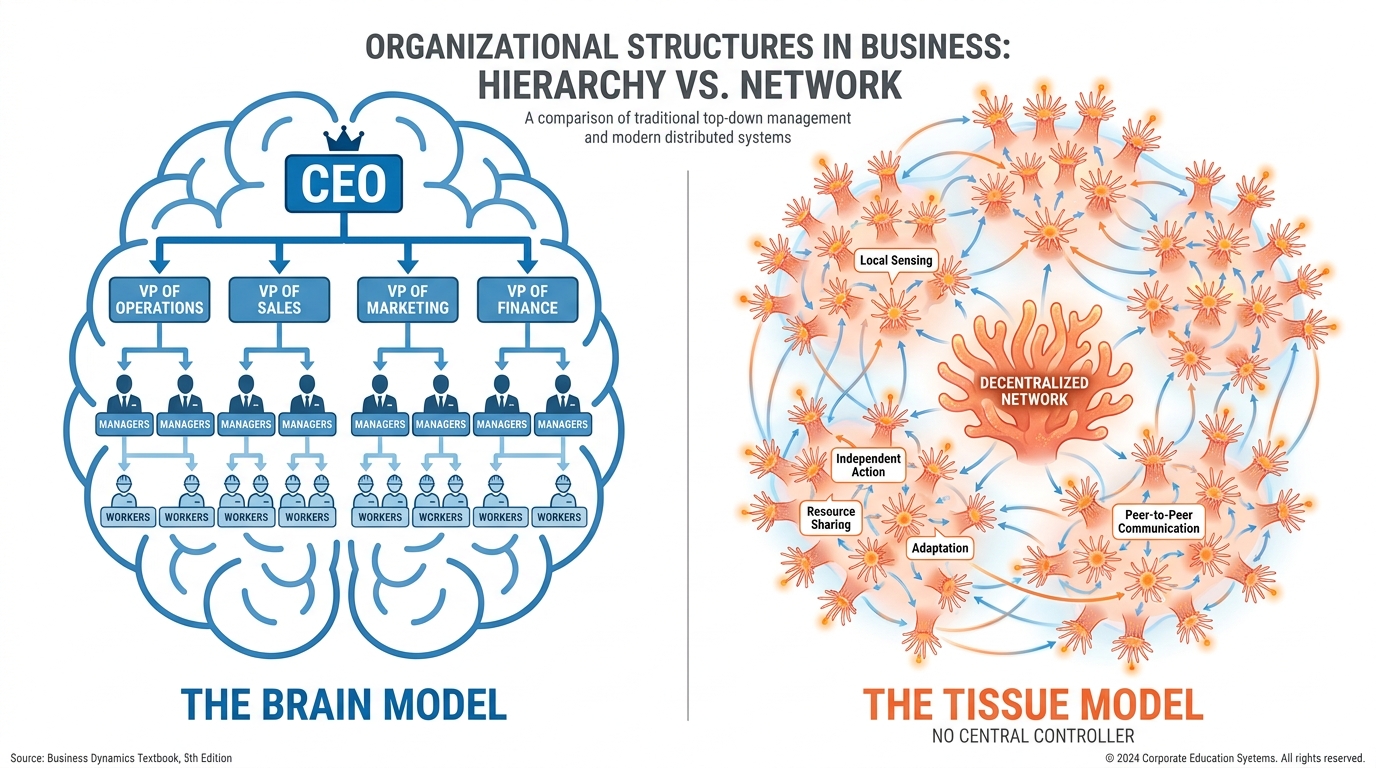
Figure 1:Basal-Cognitive Architecture — The brain era is ending. The tissue era is starting. The question is not whether your organization will change. It is which metaphor you build it around.
On a Saturday morning in the spring of 1956, Alfred P. Sloan sat in his office at the General Motors Building in Detroit and looked at the org chart he had spent thirty years perfecting. It was beautiful. A pyramid. At the top, a single executive — himself, until recently. Below him, five division heads. Below them, fifty-three plant managers. Below them, twelve hundred middle managers. Below them, three hundred and fifty thousand people who built the cars.
Sloan had taken what was once a chaotic confederation of competing brands — Chevrolet, Pontiac, Oldsmobile, Buick, Cadillac — and turned it into the most successful industrial enterprise in human history. The structure he designed became the model for the modern corporation. Every Fortune 500 company you have ever heard of is a descendant of that pyramid. Business schools have taught it for seventy years. It was, in every sense, the brain of the company, with Sloan at the cortex.
He thought he had perfected it.
Now jump to 2026. A marine biologist named Carla Soto is on a boat off the Florida Keys, watching a coral colony spawn. Eleven billion polyps releasing gametes within a single thirty-minute window, synchronized to the moon. No CEO. No middle managers. No org chart. No central nervous system. Each polyp is a tiny, semi-independent organism with its own mouth and tentacles, making its own local decisions. And yet they build reefs that span hundreds of miles, last thousands of years, repair themselves after hurricanes, and adapt to environmental shifts that would shatter any human institution.
Soto watches this and understands something most MBAs have never been taught: the coral colony is solving organizational problems that General Motors has failed to solve since 1956.
That is the inversion this chapter is about.
The Brain Was Never the Best Metaphor
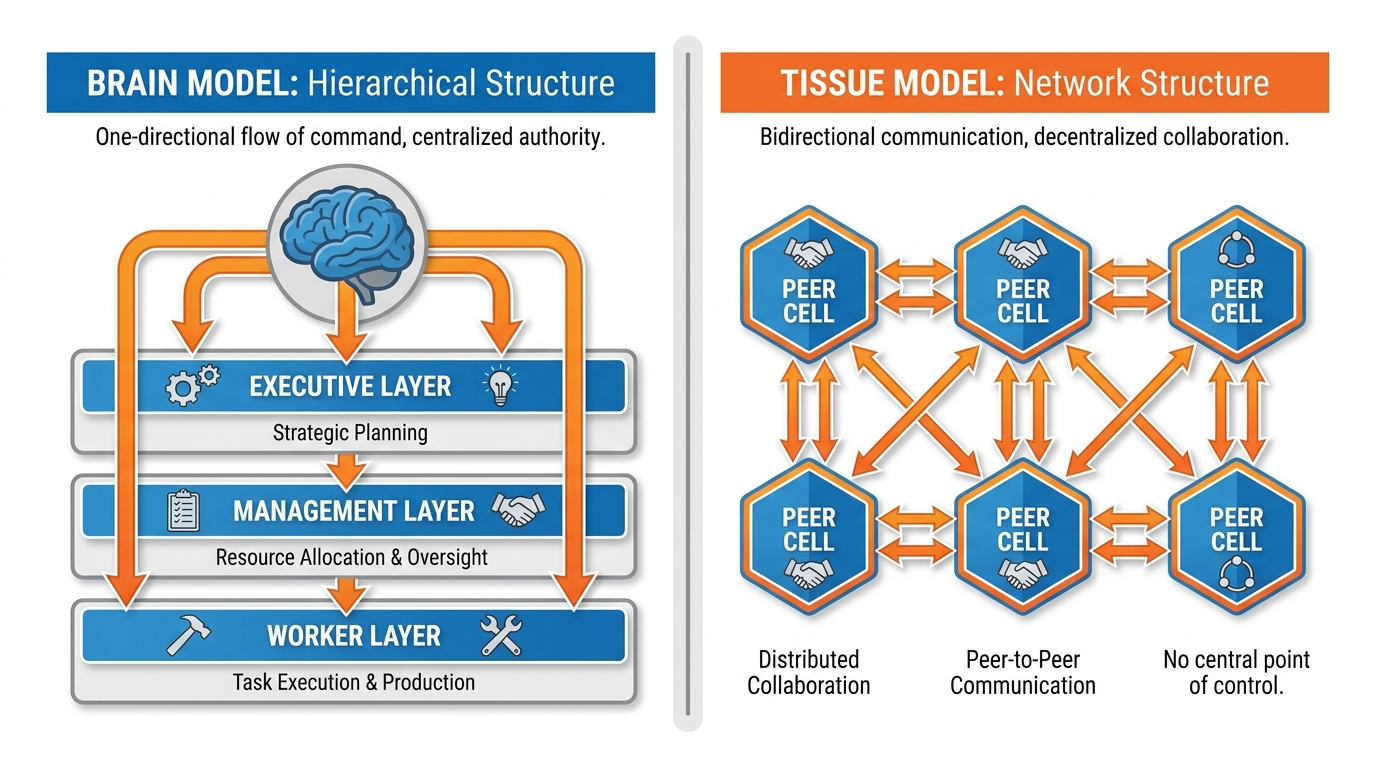
Figure 2:Brain vs. Tissue — Two ways to organize cognition. Only one of them was built for an AI-augmented world.
For two centuries we have described organizations using the language of the brain. The CEO is the head. The strategy office is the prefrontal cortex. The board is the executive function. Middle management is the spinal cord, transmitting signals from the top down. Front-line workers are the limbs, executing what the brain decides.
It is a beautiful metaphor. It is also, almost entirely, wrong.
Here is the problem nobody talks about. Three billion years of biological evolution have run an extraordinary experiment in how living systems organize themselves. The result is overwhelmingly clear: most successful biological systems are not hierarchical. The brain is one of the rarest organizational forms in nature, not one of the most common. Most of life, by mass, by species count, and by sheer evolutionary success, organizes itself through what biologists now call basal cognition — distributed sensing, local decision-making, and emergent coordination without a central controller.
Bacterial colonies. Fungal mycelia. Slime molds. Coral reefs. Ant colonies. The microbiome inside your gut. Even the human body itself — at the tissue level, your liver does not consult your brain about how to detoxify a substance. Each hepatocyte makes local decisions based on local signals. The brain coordinates the whole organism, yes, but the brain does not run the organism. Most of the organism runs itself.
For two hundred years, we have organized companies as if the brain were the only valid model of intelligence. Three billion years of evolution disagrees.
The reason the brain metaphor felt right for so long is that it matched the era. In an industrial economy, the scarce resource was muscular effort, and the bottleneck was coordination. A hierarchy minimizes the cost of coordinating expensive labor toward a few well-defined outputs. When you are building Model Ts on an assembly line, you genuinely do want one brain making the design decisions and a million hands executing them.
But that economy is gone. The scarce resource is no longer muscle. It is not even attention anymore — Chapter 0 explained why. The scarce resource is direction of judgment. And when the scarce resource changes, the organizational form must change with it.
This is not a prediction. It is a structural inevitability. The companies that figure it out first will look strange to everyone else for about three years. Then they will look like the only sane companies left.
Why Hierarchical Orchestration Breaks
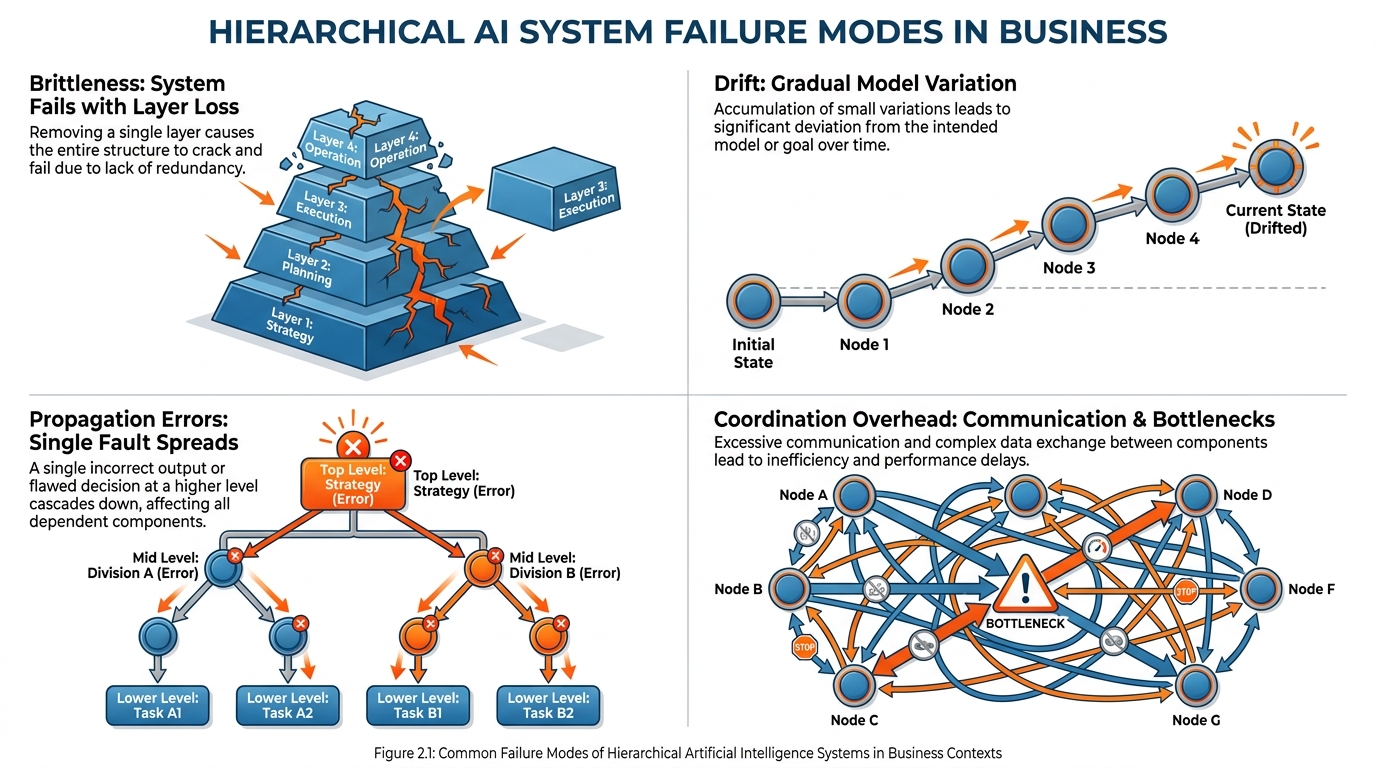
Figure 3:The Four Failure Modes of Brain-Style AI — Predictable. Repeatable. And they get worse when you add more AI to the hierarchy.
When companies first started adding AI to their operations in earnest — roughly 2023 through 2025 — almost every one of them did the same thing. They took their existing org chart and asked: where do we bolt the AI on?
Some put it at the top: an “AI Council” that reviewed strategy. Some put it in the middle: a center of excellence that vetted AI use cases. Some pushed it to the edges: chatbots for customer service, copilots for engineers. Whatever the variation, the underlying instinct was the same. The hierarchy was the given. The AI was the new tool that had to fit into it.
This produced four predictable failures, and you can find every one of them in the post-mortems of the 2025 enterprise AI deployments that quietly disappointed their boards.
Brittleness. In a hierarchical AI system, the top-level orchestrator becomes a single point of failure. When the master prompt is wrong, every sub-agent below it inherits the wrongness. When the orchestrator misreads the task, the entire tree below it executes the wrong work, faster and more thoroughly than ever before. The pyramid amplifies errors instead of catching them. One bad call at the top wastes a thousand executions at the bottom.
Drift. In any long-running hierarchical workflow, the further you get from the original instruction, the more the meaning erodes. A directive that meant one thing at the top means a slightly different thing at the third sub-agent, and a fundamentally different thing by the seventh. This is not an AI quirk. It is the same telephone game that has plagued human bureaucracies forever. Adding AI does not fix it. AI just plays the telephone game faster.
Propagation errors. When a sub-agent in a hierarchy makes a mistake, the mistake does not stay local. It flows downstream. The next agent in the chain treats the bad output as ground truth. By the time the error surfaces — usually only when a human reviews the final artifact — the wrong assumption has been baked into ten downstream documents. The cost of correction is not the cost of one bad agent. It is the cost of every agent that built on its output.
Coordination overhead. The single most underrated cost of hierarchical AI is the cost of just keeping the hierarchy coordinated. Every sub-agent has to be briefed. Every sub-agent has to report. The orchestrator spends most of its token budget on context handoffs rather than on the actual work. In production deployments, organizations routinely discover that 60 to 75 percent of their AI compute is being spent on coordination, not cognition. They are paying to organize the work, not to do it.
The most expensive industry post-mortem of this era will be a 2026 analysis of why a major U.S. consulting firm spent $180 million standing up an “AI Practice” structured exactly like its human practice — partners at the top, managers in the middle, junior agents at the bottom. The structure was elegant. The org chart was clear. The deliverables were worse than the human-only baseline. Not because the AI was bad. Because the architecture forced even good AI into the failure modes of a pyramid.
Meanwhile, a regional competitor that had no AI strategy — just a quiet team of seven that built small, peer-organized agent groups by department — was eating their lunch on speed, accuracy, and client satisfaction. The competitor was running tissue. The big firm was running brain.
From Agent Corporations to Agent Tissues
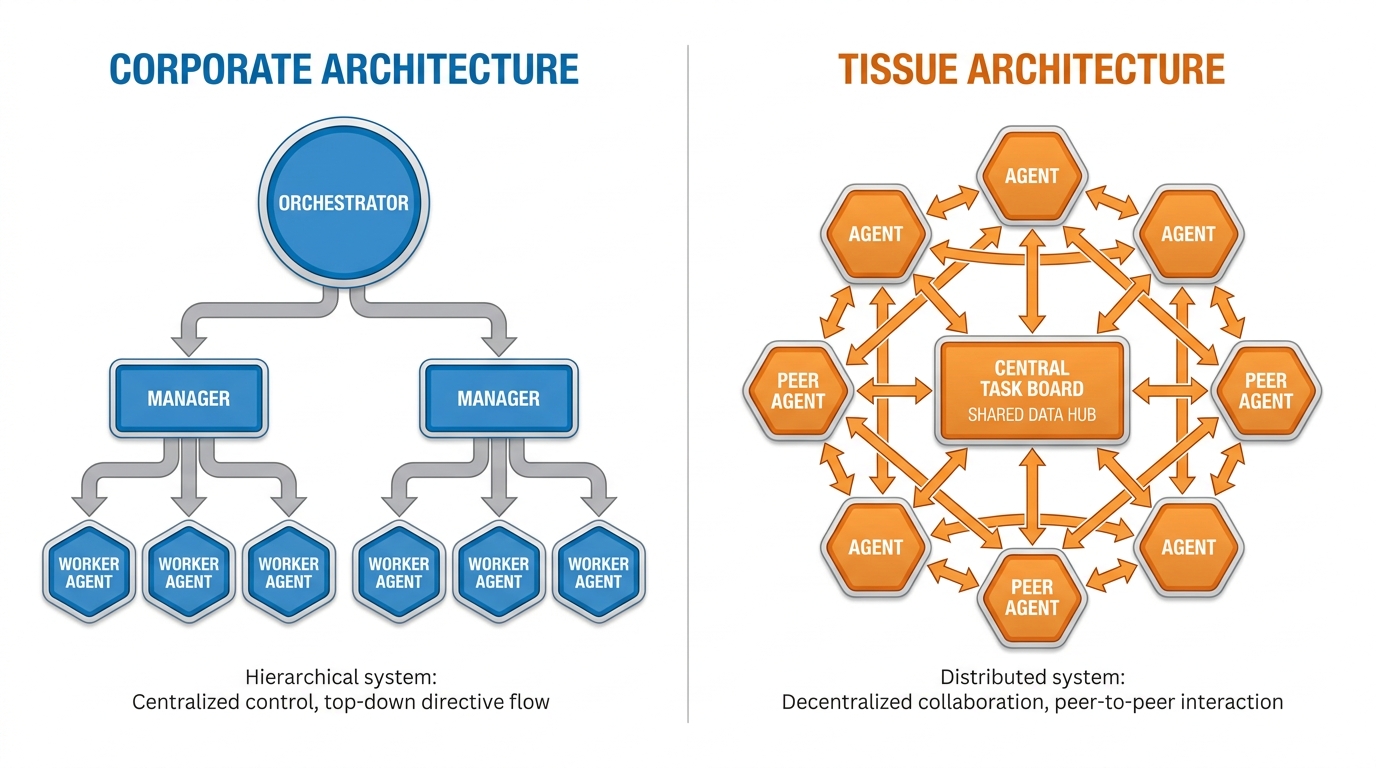
Figure 4:Agent Corporations vs. Agent Tissues — Same number of agents. Two completely different architectures. One scales. One breaks.
The shift you have to make — and you have to make it before your competitors do — is from organizing agents like a corporation to organizing them like a tissue.
In an agent corporation, there is an orchestrator and there are sub-agents. The orchestrator decomposes the task, hands chunks to specialists, collects their outputs, and assembles the result. This is exactly the architecture that Chapters 9, 10, and 11 of this book taught you to build — and you should know how to build it. It works beautifully for bounded, well-decomposable problems. A research brief. A multi-source summary. A coding task with clear sub-modules. For those, the corporation is the right shape.
But most real business work is not like that. Most real business work is open-ended, context-dependent, and unpredictable. The information needed to do the work well does not live at the top of the hierarchy. It lives at the edges, in the people closest to the customer, the data, the decision. A hierarchical architecture forces all of that local information to be summarized, abstracted, and passed upward — losing fidelity at every step — so the orchestrator can decide. By the time the decision comes back down, the local context has been stripped away. The decision is wrong, or generic, or both.
In an agent tissue, the architecture is inverted. There is no orchestrator. There are peer agents. Each agent has its own local context — its own corner of the data, its own customer relationship, its own slice of the workflow. They communicate with each other directly when they need to. They coordinate through a shared task board, not a chain of command. Each agent senses its environment, makes local decisions, and only escalates upward when local sensing tells it the situation exceeds local authority. The work emerges from the bottom, not the top.
This is exactly how a coral colony builds a reef. No polyp has a blueprint. No polyp knows what the whole structure looks like. Each polyp lays down its own calcium carbonate based on what it senses locally — the angle of the light, the flow of nutrients, the proximity of neighbors. And out of those millions of local decisions, a reef emerges that is more complex, more durable, and more adapted to its environment than any centralized engineer could have designed.
The early evidence for tissue architectures in AI is already overwhelming. The most successful production AI deployments of 2025 — at GitHub, at Stripe, at Bloomberg, at a half-dozen quietly excellent operations teams across mid-market finance — share the same shape. Small, focused peer agents. Shared memory. Local sensing. Explicit handoffs through structured task lists, not through a master prompt. When something goes wrong, only the local agent has to be debugged. When something needs to change, only the local agent has to be updated. The system is fault-tolerant by construction.
This is not a rejection of orchestration. Orchestration still has a role — for bounded tasks, for the moments when the work genuinely does decompose cleanly. But the default architecture of your AI operations should not be the corporation. It should be the tissue. Reach for orchestration only when the task forces you to. The rest of the time, let the work emerge from peer agents sensing their own local context.
This is harder to design. It is also incomparably more resilient once it is built.
The Cognitive Light Cone
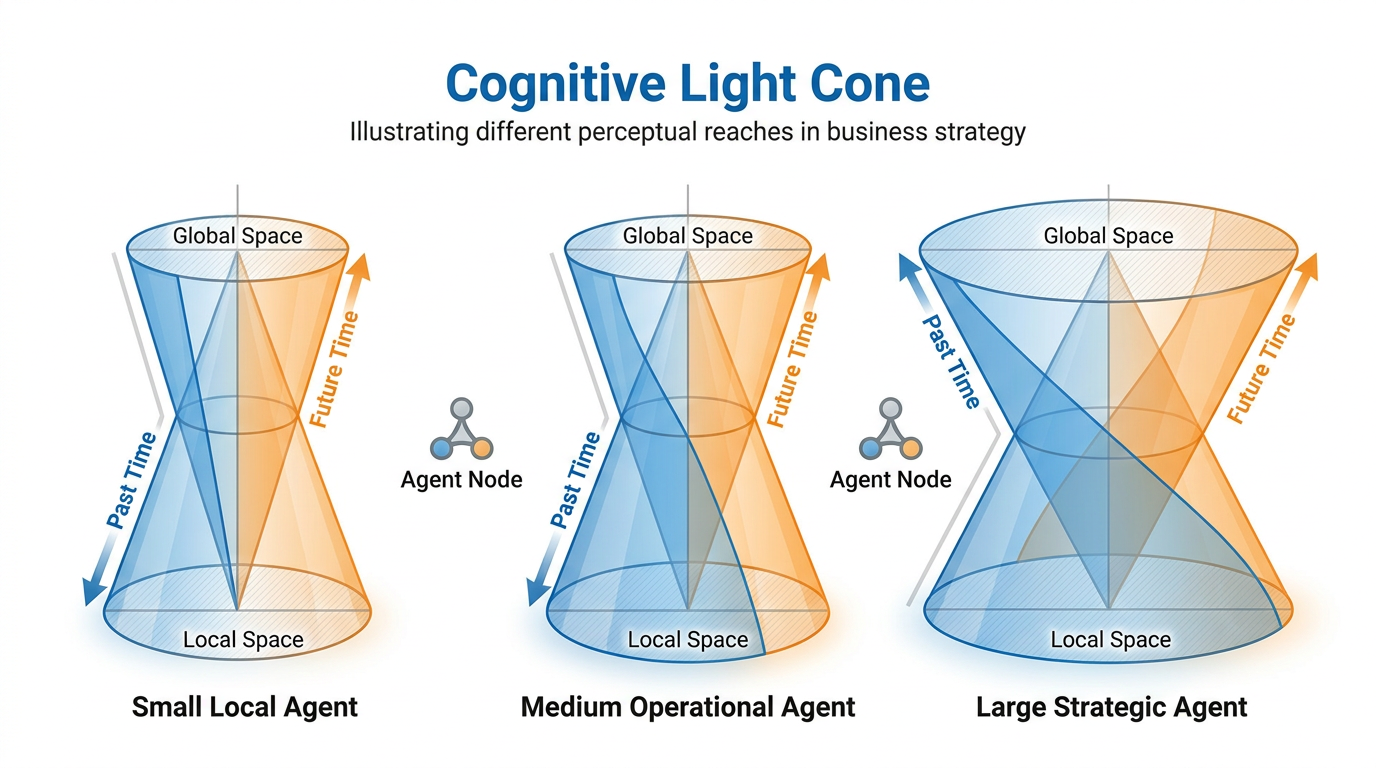
Figure 5:The Cognitive Light Cone — Every agent and every unit has one. Most organizations have never measured theirs. The size of the cone determines the size of the decisions the unit can make well.
There is a concept that cognitive scientists borrowed from physics that turns out to be the single most useful design parameter for AI architecture. They call it the cognitive light cone.
In physics, a light cone is the region of space and time that an event can causally affect. Light travels at a finite speed, so any event has a bounded sphere of influence. Outside the cone, the event cannot be perceived or responded to. Inside the cone, it can.
In cognitive science, the same idea applies to any thinking system. Every agent — biological or artificial — has a cognitive light cone: the region of time and space across which it can sense, integrate information, and act. A bacterium has a tiny light cone. It can sense chemicals in the millimeter around it and respond within seconds. A human has a much larger one. You can integrate information across years, plan for decades, and act on signals from the other side of the planet. A national government has a larger one still, in principle, although in practice its cone is often smaller than a competent founder’s.
Here is the design insight. Every AI agent you build also has a cognitive light cone. And the size of that cone is determined by you, the designer — by how much context you give it, how long its memory persists, how far it can reach into the systems around it, and how often it gets to act.
The mistake most architects make is to assume the cognitive light cone is set by the model. It is not. The model is the engine. The light cone is the design. A weak model with a well-designed cone will outperform a strong model with a badly-designed one. This is why you keep hearing about teams who switch to a smaller, cheaper model and somehow get better results. It is not magic. They are accidentally fixing the cone.
In a brain-style architecture, all the cognitive light cones are stacked. The orchestrator’s cone is the biggest, and everything below it is smaller. This sounds elegant. In practice, it means the agent at the top is the only one that can see the whole picture, and the agents at the bottom are operating with cones so small they are practically blind. Information has to travel up and down the stack to be useful, and at every transit it loses fidelity.
In a tissue-style architecture, the cones overlap. Each agent has a medium-sized cone, large enough to make local decisions but small enough that the agent stays focused. The cones overlap with neighboring agents, which means information can flow peer-to-peer without having to round-trip through an orchestrator. The total area covered by the union of all the cones is the system’s effective cognitive reach — and in a well-designed tissue, that reach is far larger than any single agent could provide.
A small example makes this concrete. A national insurance company in 2025 tried to build an “AI claims handler” — a single large agent that would handle a claim end-to-end, from first notice of loss through payout. They gave it access to everything: the policy database, the medical records, the fraud detection system, the payment system. The cognitive light cone was enormous. The model was state of the art. And the system was a disaster. The agent kept making confidently wrong decisions because it had too much to look at and no clear sense of which part of its cone was relevant to the task at hand.
A small competitor redesigned the same workflow as a tissue. Five small agents, each with a tightly-bounded cone: one for intake, one for documentation, one for medical review, one for fraud signals, one for payment. They communicated through a shared task list that the customer’s claim moved across like a stone skipping on a pond. The total system covered the same ground as the giant. But each agent was focused enough to be reliable. The combined accuracy was 31 percent higher. The combined latency was a quarter. And when the team needed to update the fraud logic, they updated one agent — not the whole stack.
That is the cognitive light cone at work.
The Six Dimensions of Basal-Cognitive Architecture
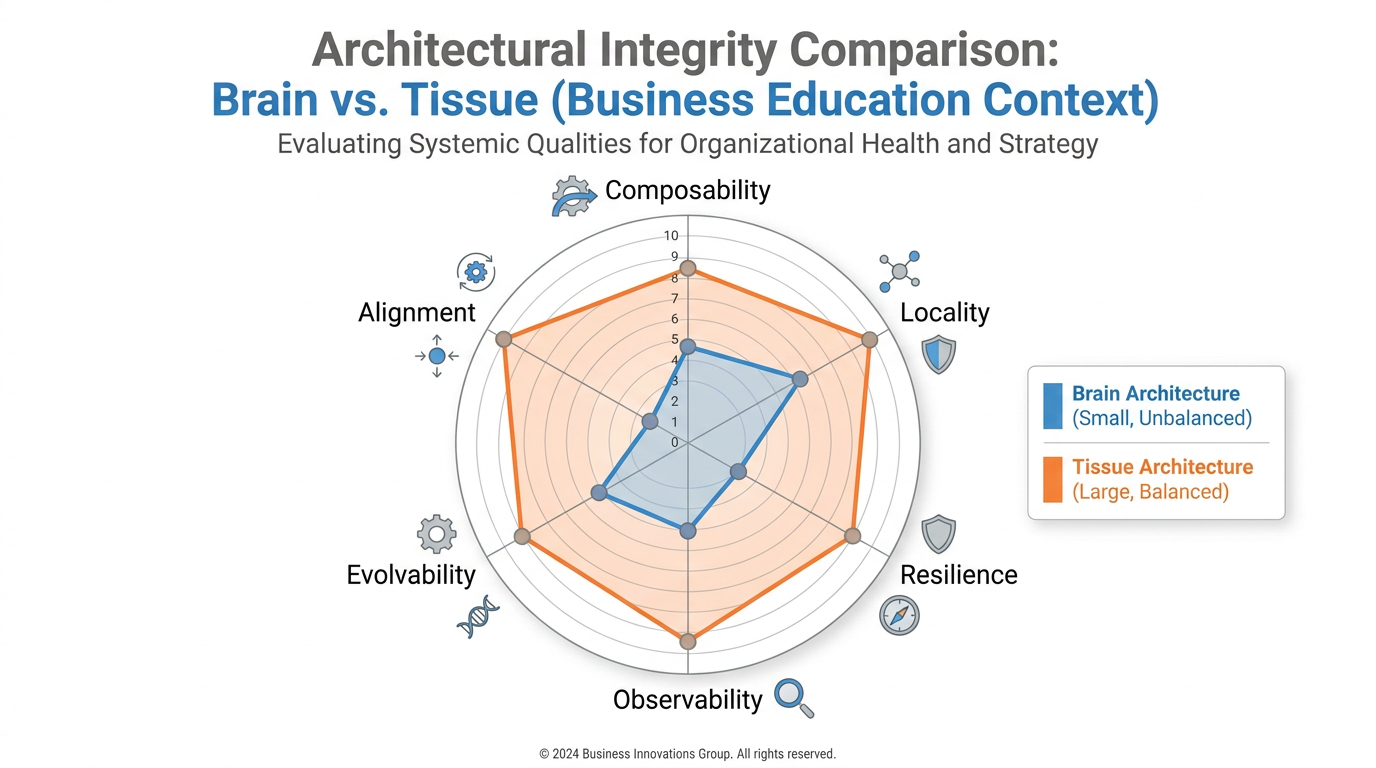
Figure 6:Six Dimensions — The diagnostic for whether your AI architecture was built for the brain era or the tissue era. Brain architectures plot as spikes on a few axes. Tissue architectures plot as balanced shapes.
If “tissue versus brain” is the philosophical frame, the six dimensions below are how you actually evaluate an architecture in practice. Walk every AI system in your organization through these six questions. The shape of the answers will tell you immediately whether you have built something durable or something fragile.
1. Composability. Can the unit be combined with other units to build larger systems without redesigning either? In a tissue, every agent is composable by construction — it has clean inputs, clean outputs, and no hidden dependencies on a controlling orchestrator. In a brain, agents are tightly coupled to their position in the hierarchy. You cannot easily lift a sub-agent and use it in a different context. Composability is the difference between Lego bricks and a sculpture. The same parts. Wildly different reusability.
2. Locality. Does the unit make decisions based on local context, or does it have to round-trip to a central authority for routine choices? Locality is the speed of the system. A unit that has to ask permission for every move is slow regardless of how powerful its underlying model is. A unit that can act on local signals — within its cognitive light cone — is fast and adaptive. Locality is the difference between a coral polyp that responds to its environment in seconds and a corporate decision that has to climb six layers of approval before anyone acts.
3. Resilience. What happens when a single unit fails? In a brain, the system shudders. Critical paths break. The orchestrator panics. In a tissue, neighboring units pick up the slack or the system simply routes around the failure. A coral colony loses 20 percent of its polyps to a storm and rebuilds them within a season. A corporation loses one senior executive and stalls for six months. The difference is structural, not cultural.
4. Observability. Can you tell what each unit is doing, in real time, without disrupting it? In a tissue, every agent exposes its state, its decisions, and its task list to the shared substrate. You can watch the work happen. In a brain, the orchestrator’s reasoning is often opaque, the sub-agents’ contributions get bundled into a final artifact, and by the time you can review the output the work is done. Observability is the difference between flying a plane with a cockpit and flying it through a curtain.
5. Evolvability. Can the system change without a major redesign? A tissue is evolvable because each agent is replaceable in isolation. You can upgrade one agent — better prompt, newer model, refined skill — without touching the others. A brain is fragile to change because every component assumes the orchestrator works a particular way, and updating the orchestrator means cascading updates everywhere. The companies that win the next five years will not be the ones who picked the best AI in 2026. They will be the ones whose architecture can absorb whatever AI exists in 2028, 2029, and 2030 without a re-platforming event.
6. Alignment. Does the unit’s local objective align with the system’s global objective, or does it have to be coerced into cooperation? In a well-designed tissue, every agent has an objective that, when pursued locally, contributes to the global outcome. No coercion required. In a brain, alignment is enforced from above through prompts, monitoring, and intervention. The moment the monitoring breaks down, the agents drift. Alignment-by-design is durable. Alignment-by-policing is not.
Six dimensions. One framework. The teams that can sit in a room and rate their architecture honestly across these six axes are the teams that will own the next decade. The teams who answer “we’re an AI-first company” without being able to plot themselves on the six dimensions are saying the words but doing none of the work.
Composing Across Scales
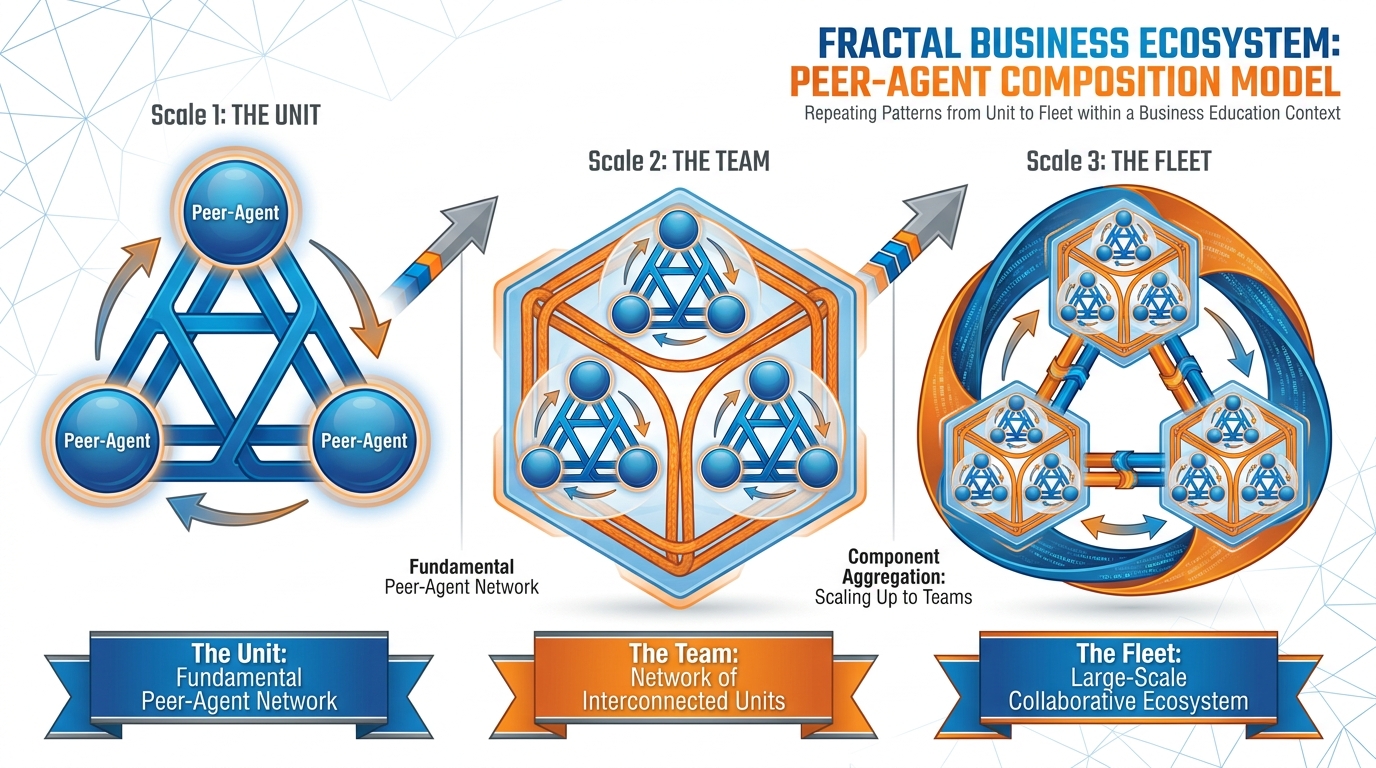
Figure 7:Composing Across Scales — The fractal property of tissue architectures. The same pattern works at one agent, ten agents, ten thousand agents. The org chart of the future is not a pyramid. It is a fractal.
There is one property of basal-cognitive architecture that, once you see it, changes how you design everything else. It is the fractal property: the same organizational pattern works whether you have one agent, one hundred, or one hundred thousand.
In a coral reef, a single polyp uses local sensing and emergent coordination to lay its calcium carbonate. A cluster of polyps uses the same pattern — local sensing, emergent coordination — to form a colony. A colony uses the same pattern, again, to interact with other colonies and form a reef. A reef uses the same pattern to interact with other reefs and form the Great Barrier Reef. At every scale, the same architecture. Same locality. Same composability. Same resilience.
A brain does not work this way. The brain has fundamentally different architecture at different scales — a neuron does not work like a cortical column does not work like the whole brain. This is a major reason brain-like systems are so hard to scale. You have to redesign the architecture at each level.
When you design your AI systems on tissue principles, you get the fractal property for free. The same patterns you use for a single agent — clean inputs, local context, peer communication, observable state — work for a team of agents. The same patterns that work for a team work for a department. The same patterns that work for a department work for the whole company.
This is what enables organizations of the next decade to scale from ten AI agents to ten thousand without going through the agonizing replatforming that every Industrial-era company went through when it grew from 100 employees to 10,000. The architecture is the same all the way up. You just add more units.
The principle is simple and counterintuitive: design for the smallest unit, then compose. Not the other way around.
Most companies do the reverse. They design for the org chart they already have, then try to squeeze AI into the boxes. This guarantees the AI inherits all the dysfunctions of the existing hierarchy. The work does not get faster. It just gets faster at being wrong.
The discipline is to ignore the org chart entirely when you design your AI architecture. Start with the smallest unit of work that can be done by a single agent within a single cognitive light cone. Get that unit working beautifully. Then compose. Two agents working as peers. Then five. Then a department. Then a company. At every step, you are applying the same six dimensions and the same architectural pattern. The org chart, eventually, will reshape itself around the architecture — not the other way around.
This is the most important sentence in this book, so read it twice: the architecture you choose for your AI is, over time, the architecture of your company.
The Robustness Test
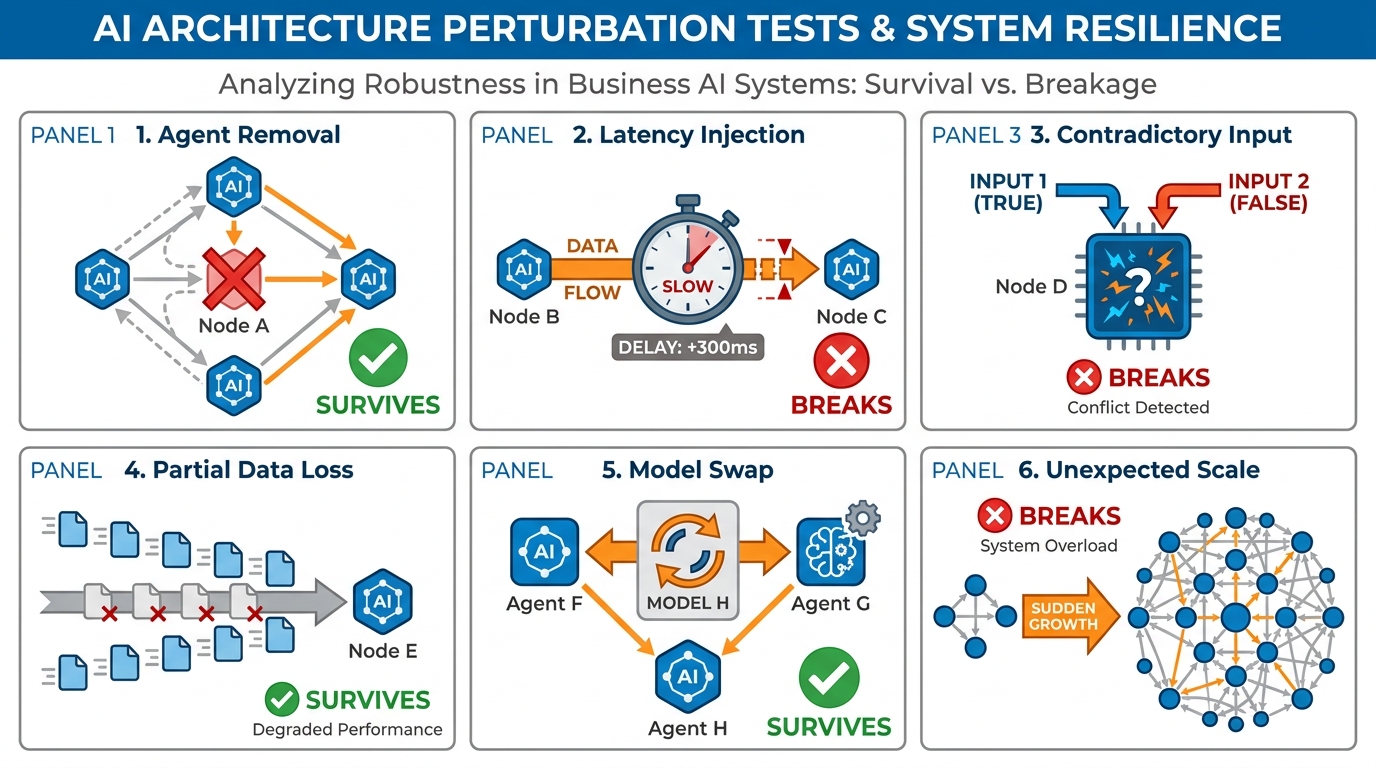
Figure 8:The Robustness Test — Six perturbations. Pass them all and you have a tissue. Fail more than two and you still have a brain wearing tissue clothes.
You can debate philosophy all day. The architecture that survives is the one that survives perturbation. So here is the diagnostic — six perturbations to apply to any AI system you have built. Pass all six and you have built a basal-cognitive architecture. Fail more than two and you are still operating in the brain era, regardless of what you call it on the slide deck.
Perturbation 1 — Agent Removal. Pick a random sub-agent in your system. Disable it for twenty-four hours. Does the rest of the system continue to function in a degraded but useful state, or does the whole system halt? A tissue continues. A brain stops.
Perturbation 2 — Latency Injection. Add a five-second artificial delay to one of your inter-agent communications. Does the system gracefully tolerate the delay, or does the orchestrator time out and crash? A tissue tolerates. A brain has rigid timing assumptions baked in.
Perturbation 3 — Contradictory Input. Feed two of your agents directly contradictory information about the same underlying fact. Does the system surface the contradiction for resolution, or does it confidently proceed with whichever version one of the agents happened to see first? A tissue surfaces the conflict. A brain swallows it.
Perturbation 4 — Partial Data Loss. Simulate the loss of half the context an agent normally has access to. Does the agent reason about the gap and ask for what it needs, or does it confidently hallucinate the missing context? A tissue knows what it knows. A brain confabulates.
Perturbation 5 — Model Swap. Replace the underlying model of one of your agents with a different model — same family, different size, or even a different vendor. Does the system continue to function, or do you discover that the system was tightly coupled to the specific behavior of the original model? A tissue is model-agnostic. A brain is hostage to its model.
Perturbation 6 — Unexpected Scale. Send the system ten times its normal volume of work in a single hour. Does it degrade gracefully — queueing, prioritizing, slowing — or does it fall over entirely? A tissue queues. A brain collapses.
Most organizations have never run any of these tests. They have built AI systems that work beautifully in the demo and fail quietly in the field, and they will never know which one of the six perturbations took them down because they never measured. The teams that win the next decade will run this test on their AI systems the way good engineering teams run chaos tests on their production infrastructure. It is the same discipline. It is the same payoff.
If you remember nothing else from this chapter, remember this: a system that has never been perturbed in a test environment will be perturbed for the first time in production. And production is the worst possible place to discover that you have built a brain when you needed a tissue.
Case Study: The Calder Industries Restructure
Background
Calder Industries is a 92-year-old industrial conglomerate headquartered in Chicago, with $14.3 billion in annual revenue across four divisions: industrial equipment, building materials, specialty chemicals, and aerospace components. The company employs 38,000 people across 47 facilities in 14 countries. Its current org chart — a six-layer pyramid that includes a CEO, four division presidents, sixteen senior vice presidents, eighty-three vice presidents, three hundred and forty directors, and roughly twelve hundred managers — was last redesigned in 1994 by McKinsey and has been the operational backbone of the company ever since.
In late 2025, Calder’s board recruited a new CEO: Marcus Vance, a 51-year-old former operating partner at a private equity firm who had spent the previous four years restructuring industrial businesses around AI. Vance arrived with a mandate from the board: figure out what Calder’s operating model needs to look like in 2030, and start building it now. The board gave him a five-year window and a $400 million transformation budget. They did not give him a roadmap.
Vance spent his first sixty days listening. He spoke to 312 employees across all four divisions, from line workers to the CFO. He spoke to nine of Calder’s largest customers. He spoke to three retired Calder executives, including the former COO who had been part of the 1994 restructure. He read every internal post-mortem of the last decade of failed strategic initiatives. By February of 2026, he had identified what he believed was the single most important architectural decision he would make as CEO.
The Situation
The decision came to a head in a five-hour board meeting on March 4, 2026.
On one side of the table sat Calder’s incumbent leadership — the four division presidents and the COO — arguing for what they called the “Augmented Hierarchy.” Under this plan, Calder would invest $400 million in adding AI capabilities to every existing box on the org chart. Each division would get an AI strategy office. Each senior VP would get an AI executive assistant. Each director would get an AI analyst. Each manager would get a workflow co-pilot. The hierarchy would remain intact. AI would be the layer that made every existing role more productive. The pitch was internal alignment: minimal disruption, no painful restructure, predictable rollout, measurable ROI per box.
On the other side sat Vance and a small team he had quietly assembled in his first sixty days — a former architect from a tier-one AI lab, two of Calder’s youngest plant managers, and a McKinsey alumna who had been openly critical of the 1994 design ever since she helped write it. This team argued for what they called the “Tissue Restructure.” Under their plan, Calder would dissolve the six-layer hierarchy across the next 36 months and reorganize into roughly 240 small, semi-autonomous operating units — each unit a mix of 30 to 60 humans plus a tissue of peer AI agents. Each unit would have its own P&L, its own customer relationships, and its own decision authority within a clearly bounded cognitive light cone. There would be no division presidents and no senior VP layer. There would be a coordinating body — Vance called it the “reef council” — that handled inter-unit coordination, but it would have no operational authority over the units themselves. The pitch was structural: the company would absorb whatever AI advances happen between 2026 and 2030 without another restructure, because the architecture itself was already aligned with the technology.
The board was split. Three directors favored the Augmented Hierarchy on grounds of risk management. Three favored the Tissue Restructure on grounds of long-term competitiveness. The seventh director — the chair — looked at Vance and asked him to make the call.
Discussion Prompt
Using the framework developed in this chapter — the four failure modes of brain-style AI, the six dimensions of basal-cognitive architecture, and the cognitive light cone — analyze the decision Marcus Vance faces. Which approach is structurally more durable for Calder Industries over a five-to-ten-year horizon, and why? What are the realistic transition risks of the Tissue Restructure, and how could Vance design the 36-month rollout to mitigate them? If you were the seventh board member, what specific conditions would you place on whichever option you supported? Draw on at least one peer-reviewed or practitioner source to support your analysis.
Discussion Guidelines
Initial Post (due before class)
Minimum 400 words
Directly address the discussion prompt using concepts from this chapter
Include at least one APA-formatted citation — from the course text or a peer-reviewed source
Avoid summary; demonstrate analysis and original thinking
Peer Responses (minimum 2)
Minimum 250 words each
Each response must include at least one APA-formatted citation
Engage substantively — build on, challenge, or offer a contrasting perspective grounded in evidence
“I agree” or “Great post” responses do not meet the requirement
Maintain a professional and respectful academic tone
Applied Exercise: Diagnose Your Architecture and Sketch the Tissue Version
Estimated time: 30–40 minutes. You’ll produce two artifacts — a written diagnostic of one of your current workflows scored against the six dimensions of basal-cognitive architecture, and a one-page sketch of what that same workflow would look like if you redesigned it as a tissue.
This is the book’s closing lab. Use it to convert everything you have learned into a single, concrete redesign you can take into your next quarter. Pick a workflow you actually run today — something with three or more handoffs, something that currently feels brittle, something where you suspect there is a better architecture but you have not had the language to describe it. Now you have the language.
Before starting either track, if you have not already worked through the Claude Code quickstart, start there: https://
Track A — Claude Desktop
Estimated time: under 10 minutes. The capstone, done in one conversation.
This is the business-friendly default — and the most important Track C exercise in the book. You will design the tissue version of a real workflow without writing a single line of code or configuring a single agent. The capstone is conceptual, not technical.
Open Claude Desktop (download from claude.ai/download) or use claude.ai in your browser.
Describe one workflow you currently run as a hierarchy — you assign tasks, you check back, you review outputs, you redirect. Pick something real: a weekly client deliverable, a hiring funnel, a content pipeline. Name the steps, the handoffs, and where you personally sit in the loop.
Ask Claude: “Redesign this workflow as a ‘tissue’ — a set of peer units with local decision-making and no central coordinator. What would each unit be? What would its decision boundary be? How would they sync without a manager in the loop?”
Then ask: “Run the six-perturbation robustness test on this new design. For each perturbation, tell me whether the tissue or the hierarchy holds up better.”
Save both outputs. Read them side by side. You now have a capstone artifact: a current architecture, a redesigned architecture, and a head-to-head robustness comparison. This IS the diagnostic from the chapter — and the closing lab of the book.
Your Submission: Your submission is the tissue redesign of your chosen workflow — Claude’s redesign description plus the six-perturbation robustness test results — plus your capstone reflection. Copy the redesign and test results into a document. Underneath them, write your capstone reflection (150-200 words): what is the single most important thing you are taking from this book into your professional practice? This reflection is your capstone submission. Submit the redesign + robustness test + capstone reflection.
Track B — Claude Code
In a plain text editor, write a one-page description of the current workflow you have chosen. Name the steps. Name the handoffs. Name the people or agents involved at each step. Name where the cognitive bottleneck currently lives. Be specific — generic descriptions will produce generic redesigns.
Open Claude Code. Paste your workflow description and ask: “Score this workflow on the six dimensions of basal-cognitive architecture — composability, locality, resilience, observability, evolvability, and alignment. For each dimension, give me a score from 1 to 5 and explain what evidence in my description supports the score.”
Read Claude’s diagnostic carefully. Push back where you disagree. The goal is not to receive a verdict — it is to develop your own architectural intuition by arguing with a partner who has read every word of the framework.
Now ask: “Based on this diagnostic, sketch the tissue version of this workflow. Show me the peer agents, the shared task list, the cognitive light cone of each agent, and the points of human judgment. Make zero assumptions about my current org chart — design the workflow as if I were starting from scratch.”
Save Claude’s response as your “tissue sketch.” Read it next to your original workflow. Identify the three biggest structural changes. Write a single paragraph explaining which of the three you would actually implement first, and what would have to be true about your organization for that implementation to succeed.
Your Submission: Your submission is Claude Code’s six-dimension diagnostic for your workflow, the tissue redesign you built from it, and your capstone reflection. Copy the diagnostic and redesign into a document. Underneath them, write your capstone reflection (150-200 words): looking back at the 200-word redesign sketch you wrote in Module 0, how has your thinking about redesigning work evolved over the course of this book? What would you change in that sketch today? Submit the diagnostic + redesign + capstone reflection.
Track C — Antigravity 2.0 IDE
Open Antigravity 2.0 IDE. Press
CMD+E(Mac) orCTRL+E(Windows) to switch to the Agent Manager surface — the orchestration view that lets you set up multi-agent work without code. Reference the IDE overview at https://antigravity .google /docs /ide -overview if you need orientation. Create a new Project that represents a single “tissue unit” — the smallest unit of your workflow that could be done by a single team of peer agents. In the project description, deliberately do not name an orchestrator. Instead, write: “This project is run by three peer agents — a Sensing Agent, a Decision Agent, and a Communication Agent — sharing a single task list. There is no central controller. Each agent picks up the next task it is qualified to handle and writes back what it did.”
In the task description box, paste a real piece of work from the workflow you are redesigning. Use a task where you would normally route through a manager or an orchestrator. Then start the project and watch the three agents pick up the work asynchronously.
As the agents work, observe the Artifacts panel. Note which agent picked up which sub-task, how they communicated through the shared task list, and where (if anywhere) the absence of an orchestrator caused the work to slow or stall. This is your first empirical look at how a tissue architecture actually behaves in production.
At the end, save the Project as a template for the tissue unit. Write a two-paragraph reflection: where did the tissue architecture outperform the hierarchical equivalent you have been running, and where did it underperform? This reflection is your second artifact.
Your Submission: Your submission is the three-peer-agent Project configuration you built in Agent Manager — the Project Description with no named orchestrator — plus the task output from running real work through it, plus your capstone reflection. Copy the Project Description and task output into a document. Underneath them, write your capstone reflection (150-200 words): what does “Go build the reef” mean to you, specifically, in your professional context? What is the reef you are going to build? Submit the Project configuration + task output + capstone reflection.
Reflection
Write three to four sentences capturing what you noticed about how the two tools handled the same architectural redesign. Did one feel more like a thinking partner and the other more like an operating system? Which surface made the tissue architecture feel inevitable, and which made it feel optional? And, most importantly: which of the two will you actually return to next quarter when you start the real restructure?
The End of the Book and the Start of the Career
You made it.
Sixteen chapters. Hundreds of pages. Dozens of exercises. You did not skim. You did not skip the labs. You stayed with the question. That matters more than any single technique in this book.
Here is the thesis, restated one final time so it lands. The Industrial Revolution made muscle rentable, and the operators who redesigned around the new leverage built the modern economy. The AI Revolution is making cognition rentable, and the operators who redesign around that leverage will build the next one. You are not learning a tool. You are not learning a technology. You are learning to be one of those operators — in a moment when most of your peers are still asking “how do we adopt AI?” while you have already moved on to “how do we redesign work around it?”
The book ends here. The career starts here.
When you need a refresher on any technique — sub-agents, hooks, memory, plan mode, channels, agent tissues — the Appendix at the back of this book is the index you return to. Bookmark it. The Appendix is your field manual. The chapters are your education. Use them both for the next ten years.
You will forget specific prompts. That is fine. You will forget specific tool names. They will change anyway. What you will not forget — and what no model upgrade can take from you — is the architectural instinct. The reflex to ask “is this a hook or a judgment?” The reflex to ask “what is the cognitive light cone of this unit?” The reflex to ask “am I building a brain or a tissue?” Those reflexes are the entire game.
One last thing. Most people will read about the cognition economy. A few will use it. Almost nobody will redesign around it. You are the one we wrote this book for.
Go build the reef.
Thank you for reading. Now go do the work.
— Dr. Ernesto Lee, 2026