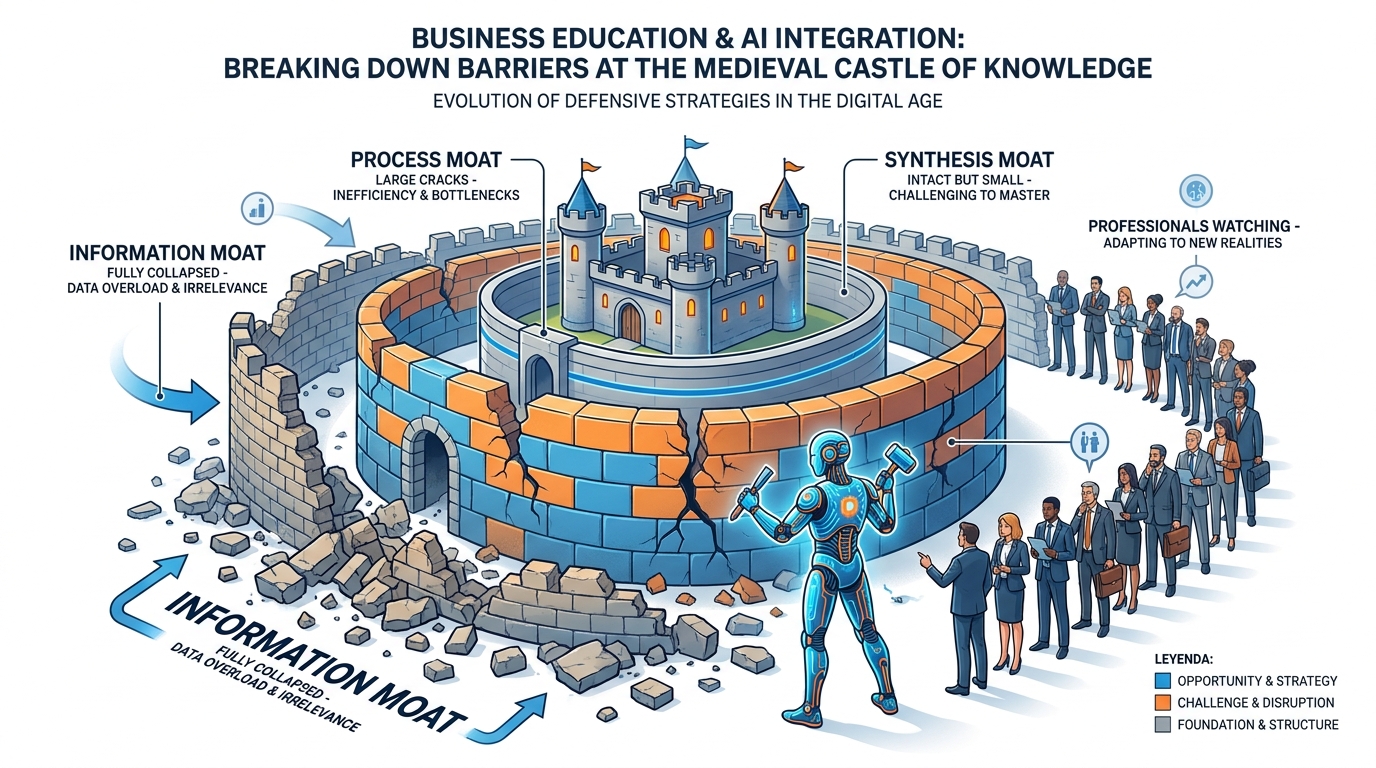
Figure 1:The Four Moats — Information. Process. Access. Synthesis. For three centuries, these were the walls behind which the professional class collected the knowledge tax. The internet took the first wall. AI is taking the next two. This chapter is about which wall is left, and how to live behind it.
A partner at a major law firm sits in his corner office on the forty-third floor. He is sixty-two. Last year he made just over four million dollars. Across from him, on the leather couch, his son sits looking at the same screen. The son is twenty-eight, two years out of law school, the firm’s most promising young associate. He bills out at three hundred and eighty an hour, makes one hundred and eighty-five thousand, and shares his father’s last name with quiet pride.
On the screen between them is a memo. A six-page response to a regulatory inquiry from the Department of Justice. The kind of document that, in 2018, would have taken a fourth-year associate two and a half days to draft, and would have billed at right around four thousand dollars before the partner ever touched it. Tight, careful, defensible.
Claude wrote it. In ninety seconds. Without a single error the father can find.
The two men do not speak for nearly a minute. The father is calculating something the son has not yet calculated. The son is calculating something the father stopped calculating thirty years ago. Each is doing the math on a different timeline. Neither math is favorable.
This chapter is about what just happened in that silence.
The Knowledge Tax
For three hundred years, the people who got rich in modern economies were not, mostly, the people who built things. They were the people who knew things.
The lawyer knew the procedure. The doctor knew the diagnosis. The consultant knew the framework. The financial advisor knew the products. The accountant knew the code. In every case, the client was paying for two things wrapped into one bill: a small amount of work and a very large amount of knowing.
Call that premium what it is. It is a tax. A knowledge tax. A surcharge that the knowing party collects from the not-knowing party for the structural privilege of being the only one in the room who understands what is going on.
This tax built the entire professional services industry. The law firm partnership model. The Big Four accounting structure. The consulting hierarchy. Wealth management. Medicine. Architecture. The taxonomies are different. The economics are identical. In each case, the senior practitioner sells access to a body of knowledge that took decades to accumulate and that the client cannot reasonably replicate. The fee is the toll for crossing that knowledge gap.
This is not a moral observation. It is a structural one. The knowledge tax is not exploitation. It is the natural consequence of an economy in which information was scarce, expensive to acquire, and slow to transfer. If you had to spend twelve years becoming a tax attorney, you charged in a way that recouped the investment. If you had to read four thousand pages of regulation to advise on a single transaction, you priced accordingly. The tax was the rational return on a real asset.
A useful business example. In 1985, if you wanted to incorporate a small business in Delaware, you paid a corporate attorney roughly twenty-five hundred dollars in today’s money to walk you through it. Most of that fee was not labor — the actual paperwork took the attorney about ninety minutes. Most of it was knowledge tax. You were paying for the attorney’s knowledge of which form to file, which clauses to include, what to avoid. In 2010, LegalZoom collapsed that fee to about three hundred dollars. The knowledge tax got partially refunded, because the knowledge had been packaged and made accessible. Today, you can incorporate in Delaware for free, in fifteen minutes, with an AI assistant that knows every clause, every common pitfall, and every state-specific quirk. The tax has gone to roughly zero.
This happened to one narrow procedure. It is now happening to almost all of them.
How Moats Get Built (and Broken)
To understand what is unraveling, you have to see clearly what was woven.
The professional class built its three-hundred-year run not on one moat but on four. Each was a different way of charging the knowledge tax. Each was constructed over centuries. And each is being attacked at a different speed.
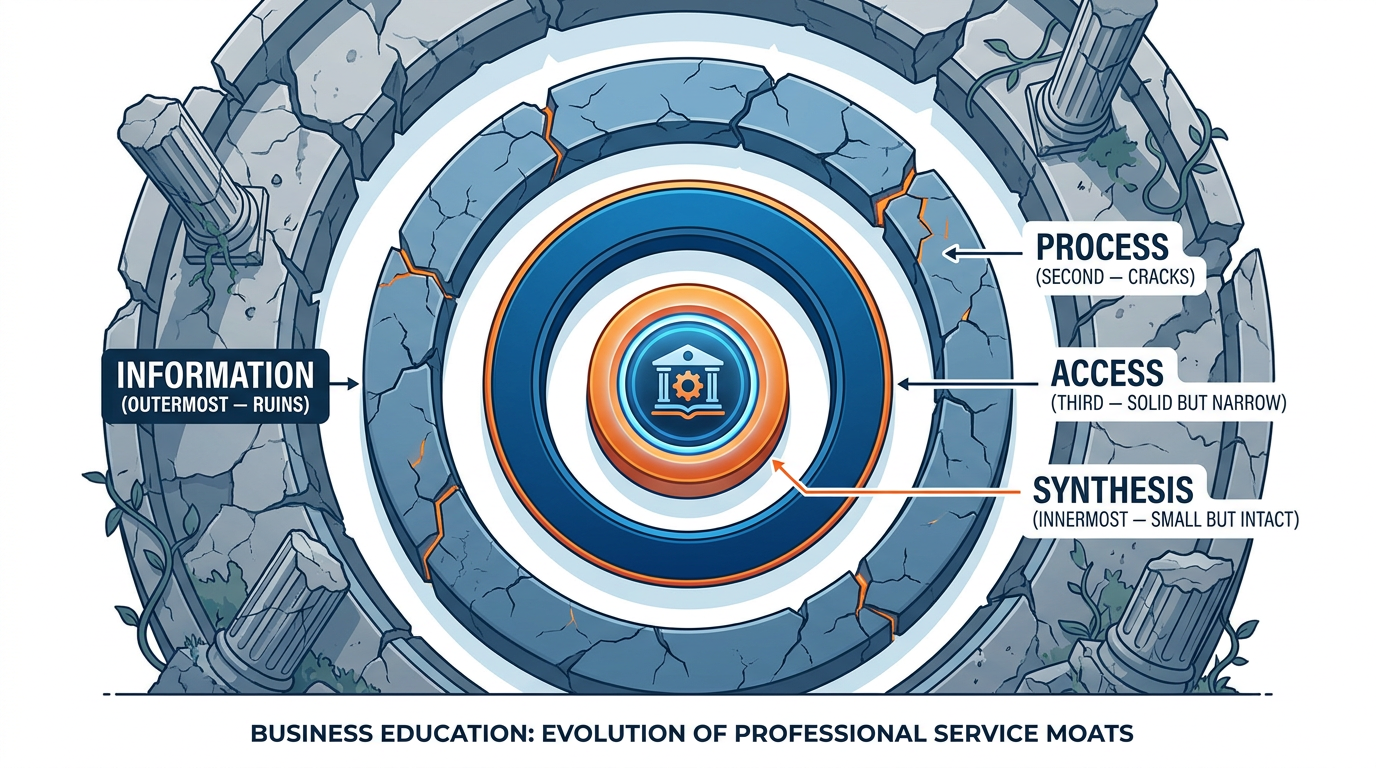
Figure 2:The Four Moats — Each one is a different way the professional class charged the knowledge tax. Each is breaking on a different timeline.
Moat One — Information. The simplest moat. You know what others don’t, because the information lives in books, archives, libraries, or in the head of someone who studied for a decade. The Encyclopaedia Britannica was a moat. A medical textbook was a moat. The CCH tax service that filled a wall of the partner’s office — that was a moat. You charged the knowledge tax because the client physically could not get to the information.
Moat Two — Process. A subtler moat. Even if the client could find the information, they did not know how to do the thing. A lawyer knows not just the rule but the procedure. A doctor knows not just the diagnosis but the differential. A consultant knows not just the framework but the sequence in which to apply it. Process is institutional muscle memory — the knowledge of which steps to take, in which order, with which judgment calls between them. For two hundred years, you could not learn this from a book. You had to apprentice for years.
Moat Three — Access. A relationship moat. You know the people. You can call the regulator. You can get a meeting with the partner at Goldman. You sit on the board with the right judge. You are licensed, certified, registered, admitted to the right bar. This moat is not about what you know. It is about whom you know and what credential lets you walk through which door.
Moat Four — Synthesis. The most prestigious moat. The ability to combine information from many domains into a novel insight — to tell a CEO what her quarterly results mean, not just what they are. This is the moat of strategy, of judgment, of taste. It is the McKinsey moat. The Warren Buffett moat. The senior surgeon’s moat. It does not look like knowledge. It looks like wisdom. But it is built on knowing how to weight, combine, and frame things others cannot.
Most professionals do not realize their income is a blend of four different revenue streams sitting on these four different moats. Their compensation does not break out by moat on the W-2. But it is there nonetheless. The fourth-year associate’s billing rate is mostly Moat 2. The senior partner’s billing rate is mostly Moats 3 and 4. The encyclopedia salesman of 1975 was selling Moat 1.
When a moat breaks, the income that rested on it doesn’t decline gracefully. It gets repriced almost overnight to whatever the next-best alternative is willing to charge. Sometimes that alternative is a competing firm. Sometimes it is software. Sometimes it is free.
Hold this picture. Four moats. Four revenue streams. Four different stories about what happens when the asymmetry collapses.
The Internet Cracked Moat One
The first moat is already gone. Most people in the professional class still don’t quite believe this, because the collapse happened gradually, and they are still collecting fees for activities the market doesn’t actually need anymore.
Here is the short version. In 1990, an Encyclopaedia Britannica salesman in suburban Connecticut could still earn six figures. The product cost about fifteen hundred dollars. Families bought it on installment plans, the way they bought refrigerators. The pitch was straightforward: your child needs access to the world’s knowledge, and this is how access is delivered. By 2012, Britannica had ceased printing the encyclopedia entirely. Not because the product got worse. The product got slightly better. It was that the market for the asymmetry it represented had been completely vaporized.
Wikipedia did not kill Britannica because Wikipedia was better. Wikipedia killed Britannica because the knowledge tax on general reference information went to zero, and any business model that depended on charging that tax — no matter how prestigious, no matter how well-edited, no matter how long-established — went with it.
This pattern repeated itself, with minor variations, across an entire generation of information professions:
The travel agent. Moat 1 collapsed when Expedia made airline schedules and hotel availability publicly visible.
The stock broker. Moat 1 collapsed when E*TRADE made stock quotes and trading screens publicly visible.
The classified-ad salesperson. Moat 1 collapsed when Craigslist made the entire concept of “we have a list and you don’t” obsolete.
The general-practice journalist. Moat 1 collapsed when blogs and search made primary sources directly accessible.
In each case, the income did not just decline. It restructured. The travel agent who survived 2005 did not survive by booking flights more efficiently. She survived by selling something the internet could not yet replicate: itinerary curation for complex high-end travel, where the value was judgment and access, not information. The brokers who survived 2010 did not survive by getting better at executing trades. They survived by becoming wealth managers — by moving up the moats from information to synthesis.
A useful business example. In 1995, an investment bank had a research department of two hundred analysts. Their job was, in part, to know things the client did not. Equity research notes. Sector deep-dives. Earnings models. The reports were physically printed and FedExed to clients. The bank charged the client a “research fee,” typically embedded in trading commissions. In 2024, those same banks have roughly forty analysts each. The other one hundred sixty did not become better at the job. They were the workforce on Moat 1, and Moat 1 is now infrastructure. The firms that bill aggressively for “research” today are billing for synthesis (Moat 4), access (Moat 3), or proprietary process (Moat 2). The pure information business is gone.
This is the pattern to internalize. When the knowledge tax on a moat collapses, the workforce that collected that tax does not get a soft landing. It either moves up or out. Hold this image as we look at the next two moats — because the same wave is now coming for them.
AI Is Attacking the Last Moats
Here is where most analysts get the story wrong. They write thinkpieces about AI as if it were a slightly better search engine. Faster information access. More convenient retrieval. A productivity tool. An incremental improvement on Moat 1, which was already gone.
That framing is comforting and it is also catastrophically incorrect.
AI does not democratize information. The internet already democratized information. What AI democratizes is process and synthesis. Moats 2 and 4. The moats the internet did not touch. The moats that, until about 2022, were considered structurally safe — the moats on which the bulk of professional-class income actually sits.
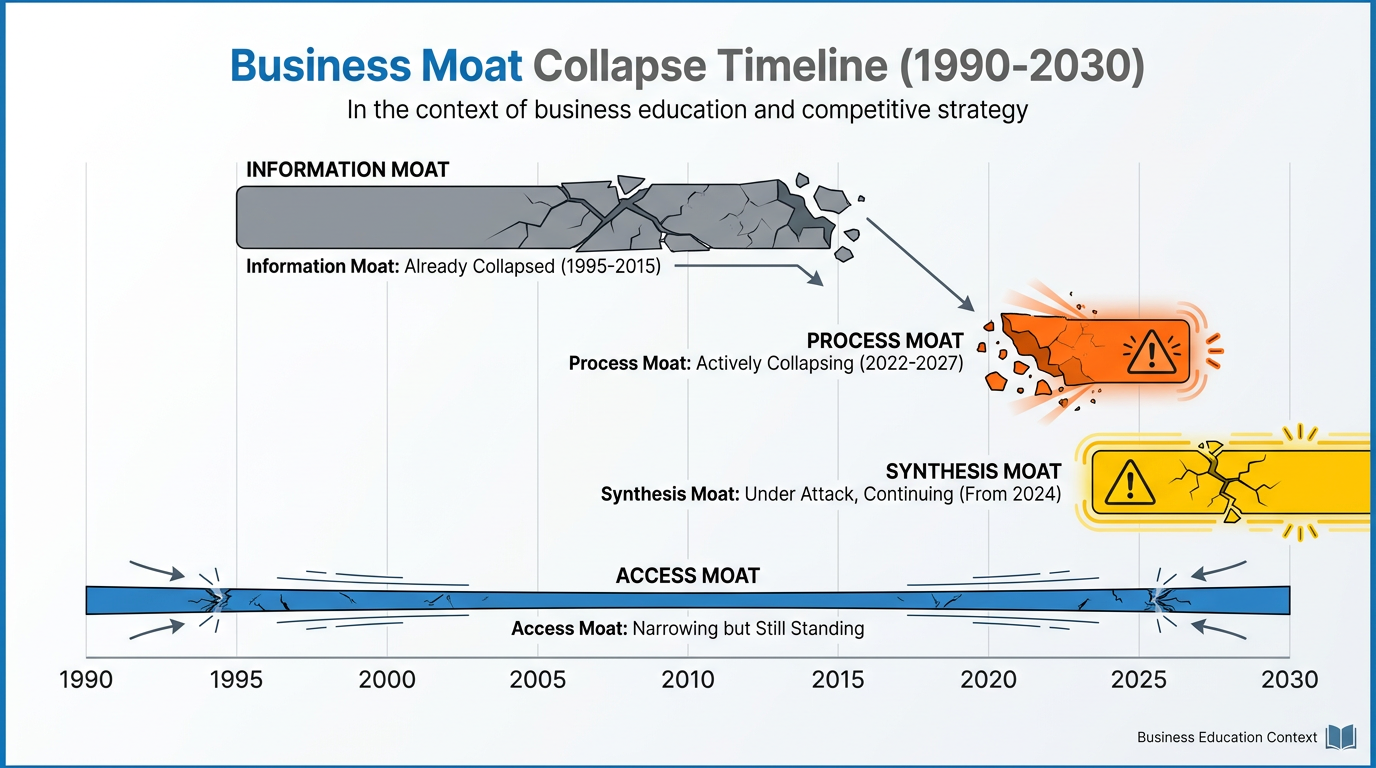
Figure 3:The Collapse Curve — Each moat is on a different timeline. The internet took twenty years to take Moat 1. AI may take five years to take Moat 2.
Watch what AI is actually doing to the work of professionals right now. It is not telling the lawyer what the law says — the lawyer already knew that. It is drafting the brief. It is following the procedure. It is performing the process the lawyer used to charge for. It is not telling the consultant what the framework says. It is applying the framework to the client’s specific situation. It is doing the synthesis the consultant used to charge for.
The end of “I know how to do this” as a premium.
For two hundred years, the phrase “I know how to do this and you don’t” was the foundational sales pitch of the entire professional class. The lawyer knew how to file the motion. The accountant knew how to structure the entity. The consultant knew how to run the analysis. The doctor knew how to read the scan. The architect knew how to draft the plans. The financial advisor knew how to build the portfolio.
Every one of these “knows how to” sentences is now contestable. Not in some far-off science-fictional future — in the current quarter, with tools that are publicly available and improving monthly. The fourth-year associate who used to draft the regulatory response is not slower than Claude. He is differently necessary. The CPA who knew the depreciation schedules is not less skilled than the AI. He is differently positioned. The strategist who knew the Porter five-forces playbook is not less smart. He is differently scarce — by which I mean, much less scarce.
This is the part most professionals are not yet allowing themselves to see clearly. There are two traditions of thinking about AI and they are not symmetrically correct. One tradition says AI is incremental — a useful tool, the way Excel was a useful tool, the way email was a useful tool. The other tradition says AI is foundational — a category shift in what is rentable in an economy, the way steam and electricity were category shifts.
The incremental view is wrong. It feels conservative. It feels prudent. It feels like the safer bet. It is not. It is the same bet the encyclopedia salesman of 1995 made when he told himself that families would always want a physical encyclopedia. It is the same bet the travel agent of 2003 made when she told herself that people would always want a human to book complicated trips. It is a bet against a structural force, and structural forces win.
A useful business example. In 2023, a Big Four accounting firm did an internal study of where it actually billed. About fourteen percent of its revenue came from work that was unambiguously Moat 4 — synthesis, judgment, strategic advice. About nineteen percent was Moat 3 — access, relationships, audit signature authority. The remaining sixty-seven percent — two-thirds of all revenue — came from Moat 2: process work. Tax preparation. Compliance reviews. Audit field work. Documentation. Modeling. Drafting. This is the work that AI is currently very good at, and is getting better at every quarter. The firm’s leadership now openly says, in private meetings, that they expect to lose between thirty and forty percent of their Moat 2 revenue over the next five years — and that they have not yet figured out what replaces it. They are not unique. They are the typical case.
Where the Premium Comes From Now
Here is the question the senior partner on floor forty-three is actually asking, even if he has not put it into words. If the old premium is going away, what is the new premium?
There is a new premium. There has been one in every previous economic transition, and there is one in this one. Three things now command the premium that information, process, and routine synthesis used to command.
Premium One — Taste. The ability to know which output is good, even when many outputs are technically correct. The AI can draft seven versions of the regulatory memo. Six of them are competent. One of them is right for this client, this regulator, this moment. Choosing among them is taste. Taste is what you get when twenty years of professional pattern-recognition is brought to bear on a question that has no algorithmic answer. Taste is not codifiable. It is what the senior partner on floor forty-three actually has, that the AI does not have, and that the second-year associate has not yet developed.
Premium Two — Judgment Under Ambiguity. The ability to make a decision when the data is incomplete, the stakes are high, and the path forward is contested. This is what executives are actually paid for. It is what surgeons are actually paid for. It is what trial lawyers are actually paid for. AI is extraordinarily good at processing information and applying procedures within defined problem spaces. It is dramatically less good — and may always be less good — at the moment when the problem itself is unclear, when the constraints are contradictory, and when someone has to call it. The professional whose career is built around that moment is not threatened. The professional whose career is built around the processing that leads to that moment is.
Premium Three — Accountability. Someone has to sign the document. Someone has to be on the hook when the strategy fails. Someone has to face the regulator, the board, the family, the jury. Accountability is not a side feature of professional work. For high-stakes work, it is increasingly the only feature that cannot be automated. The lawyer’s name on the brief means something the AI’s draft does not. The CFO’s signature on the filing means something the model’s output does not. As AI absorbs more of the production work, the value of being the legally and reputationally accountable human increases — but only for the human who is actually accountable. The associate who hands off the work is not accountable. The partner who signs is.
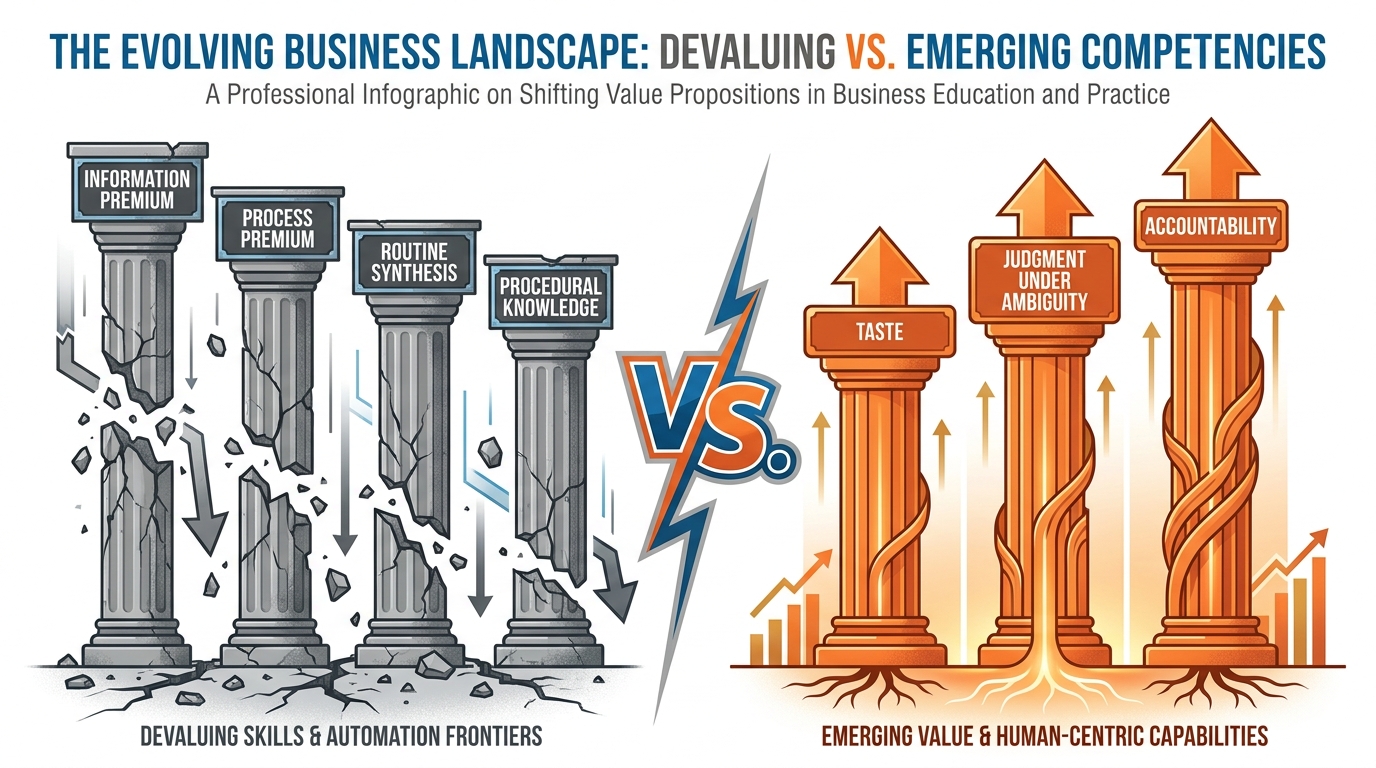
Figure 4:The New Premium Stack — Three sources of premium replacing four. The math is not symmetrical. There is less room at the top than there used to be.
Now look carefully at the math. Four old premiums. Three new ones. And the three new ones are concentrated in a much smaller portion of the workforce than the four old ones were. The encyclopedia salesman was a middle-class job in 1980. There is no equivalent middle-class job for “person of taste” in 2030. There is the senior partner who already had taste. There is the next senior partner being developed inside the firm. There are not five thousand of them per metropolitan area.
This is the part of the transition that does not get said out loud often enough. The roles that gain in this transition are the roles that already sat closest to taste, judgment, and accountability. The roles that lose are the roles that sat on processing and routine synthesis. The roles that would have been the next generation of senior partners — the associates and analysts and junior consultants who would have spent fifteen years developing taste through repetition — are now in the most awkward position of anyone. Their training ground is being automated away. They are being asked to develop senior-partner judgment without first doing twelve thousand hours of fourth-year-associate work.
A useful business example. In the past year, a top-tier litigation boutique in Chicago restructured its associate development program from the ground up. The old program had associates do roughly fifteen thousand hours of document review, deposition prep, and brief drafting over their first four years. The new program has them do roughly four thousand hours of those things — entirely as oversight and quality control on AI output — and roughly eleven thousand hours sitting in on partner-level client conversations, second-chairing high-stakes negotiations, and shadowing the firm’s three most senior trial lawyers. The firm calls the new program “taste compression.” The bet is that they can develop senior judgment in seven years instead of fifteen, by stripping out the process work that used to fill the calendar. If it works, they will have the best young partners in the country a decade from now. If it doesn’t, they will have a generation of associates who never developed any depth at all. The firm’s managing partner described the decision plainly. “We are betting that what made partners great was never the hours of grunt work. It was the exposure to the judgment calls. The grunt work was just the price of admission.”
The Builder’s Paradox
There is a strange truth at the center of this transition, and it is the truth that determines who comes out of the next decade with their professional identity intact.
The people most threatened by AI are, almost without exception, the same people best positioned to use it.
Think about who has the deepest understanding of the legal procedure that AI is now performing. The associates. The paralegals. The lawyers themselves. Not the engineers building the AI. Not the consultants writing about the AI. The people whose work AI is doing. They are the ones who know which corners are easy, which are hard, which look easy and are actually hard, which require local knowledge that no model has been trained on. They are sitting on the most valuable layer of context in the entire transition — and most of them are using it defensively, to argue that the AI can’t really do what it appears to do, that the work is more subtle than it looks, that their craft is safe.
That defensiveness is the trap.
The same lawyer who could prove the AI is missing nuance could also be the lawyer who designs a workflow where the AI handles eighty percent of the volume and the lawyer’s craft is reserved for the twenty percent where the nuance actually matters. The same accountant who could complain about the AI’s depreciation errors could also be the accountant who builds a review system that turns those errors into a learning signal, and produces work that is faster and more accurate than what either could produce alone.
The builder’s paradox is this. Your domain expertise is the most valuable thing in the room — but only if you use it to build the new system, not to defend the old one.
A useful business example. Consider two senior tax partners at the same regional accounting firm in Atlanta, both age fifty-five, both with twenty-five years of experience. Partner A spends 2024 quietly arguing in partnership meetings that “AI tax tools are not ready for prime time” and “our clients want a human.” Partner B spends 2024 building, with the firm’s IT lead, a structured workflow in which AI handles the first pass on every return, the senior associates handle a structured review, and Partner B personally handles only the complex multi-state and international cases that actually require his deepest expertise. By the end of 2024, Partner A’s book of business is essentially flat. Partner B has tripled his effective capacity. He has also, almost by accident, become the firm’s most valuable employee — because the workflow he built is the asset the firm now sells, and his name is on it. He did not stop being a tax partner. He used the fact that he was a tax partner to build something only a tax partner could build. The technology was available to both of them.
The Role Vulnerability Scorecard
Now the practical question. How exposed is your role to the knowledge-tax collapse?
Below is a six-question diagnostic. Each question scores 0 to 10. Higher scores mean greater exposure. The total, normalized to a 0-to-1 scale and weighted as shown, gives you a rough Role Vulnerability Score. The illustrative threshold is 0.65 — above that, your role’s premium is structurally vulnerable; below that, your role’s premium is more durable than most.
This is not science. It is a structured way to think.
Question 1 — Information Dependence (weight: 0.10). How much of your day-to-day value comes from knowing things others don’t know, where the knowledge is documented somewhere? (0 = none, 10 = almost all.)
Question 2 — Process Dependence (weight: 0.25). How much of your work consists of executing a defined procedure — drafting standard documents, applying standard frameworks, running standard analyses? (0 = none, 10 = almost all.)
Question 3 — Routine Synthesis (weight: 0.20). How much of your work is combining inputs into a structured output that has roughly the same shape every time — a report, a memo, a model, a deck following a template? (0 = none, 10 = almost all.)
Question 4 — Ambiguity Frequency (weight: 0.15, inverted — higher means lower vulnerability). How often does your work involve genuinely ambiguous calls where the right answer is contested, the data is incomplete, and a human has to decide? (Reverse-score: 0 = constantly, 10 = never.)
Question 5 — Accountability Concentration (weight: 0.15, inverted). How often does your name end up on the line — signed document, named recommendation, accountable decision? (Reverse-score: 0 = constantly, 10 = never.)
Question 6 — Access Dependence (weight: 0.15, inverted). How much of your value comes from relationships, credentials, or gatekeeping that someone else could not easily replicate? (Reverse-score: 0 = entirely, 10 = none.)
Compute: multiply each score by its weight, sum, divide by 10. Score above 0.65? Your role’s premium is being computed away. Score below? You are safer than most — for now.
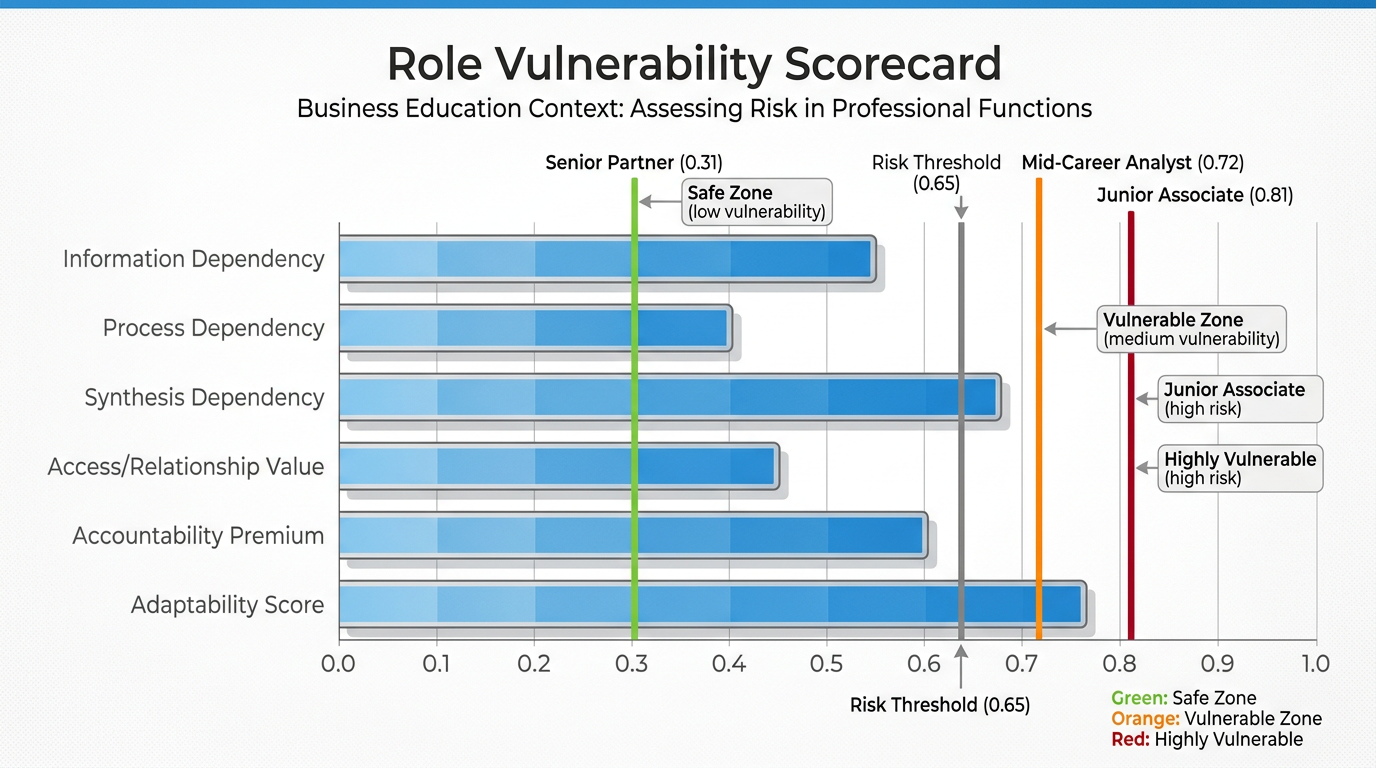
Figure 5:The Role Vulnerability Scorecard — A diagnostic, not a destiny. The number is a starting point. The next move is what matters.
Three sample profiles to calibrate against.
The senior litigation partner from the opening of the chapter scores roughly 0.31. His information dependence is low — he doesn’t get paid for knowing what’s in the statute. His process dependence is low — he stopped doing process work fifteen years ago. His routine synthesis is moderate — he still drafts strategy memos. His ambiguity frequency is very high. His accountability concentration is very high. His access is very high. He sits well below 0.65 and his moat is largely intact.
The second-year associate scores roughly 0.81. His information dependence is moderate — he still does research. His process dependence is very high — drafting, reviewing, citing. His routine synthesis is very high — most of his memos follow a structure. His ambiguity frequency is low — he doesn’t make the calls. His accountability is essentially zero — the partner signs everything. His access is low. He is far above 0.65. His role, as currently configured, is the one being computed away.
The mid-career analyst at the consulting firm scores roughly 0.72. She has built process expertise but has not yet developed the relationship and accountability premium of a partner. She is in the most awkward position of anyone — above the threshold, but with enough seniority that the firm’s expectation is she should be moving toward judgment, not staying in process. She has perhaps two years to make that move before the math gets unforgiving.
How to use the scorecard — and how not to use it.
Don’t use it to predict your fate. The score is descriptive of your role as you currently structure it. It is not a verdict on your career.
Do use it as a forcing function. If your score is above 0.65, the question is not whether to change. The question is which lever to pull first. Drop your process-dependent work and pick up more ambiguity. Find a way to put your name on outputs. Move into a role where access matters. Build a system that makes you the human in the loop instead of the human doing the work.
Don’t use it to grade other people. The scorecard is a self-diagnostic. Using it on your subordinates is bad management. Using it on your boss is worse.
Do revisit it every six months. The terrain is moving. Your score will move with it — in either direction, depending on what you do. A score that drifts down over time is the signal that you are doing the work of the transition. A score that drifts up is the signal that you are being reorganized by it.
Case Study: The Pricing Argument at Halverson Strathmore
Background
Halverson Strathmore is a 140-person management consulting firm headquartered in Charlotte, North Carolina, with secondary offices in Chicago and Denver. Founded in 2002 by Geoffrey Halverson and Marie Strathmore — both former Bain partners — the firm built a reputation for serving mid-market industrial and healthcare clients in the southeastern United States. By 2024, annual revenue had reached 850,000 to $1.4 million, and structured around a familiar arc: two weeks of data gathering, three weeks of analysis and modeling, four weeks of synthesis, and three weeks of executive presentation cycles.
Beginning in early 2024, Geoffrey Halverson — now the firm’s managing partner — became convinced that the underlying economics of these engagements were quietly collapsing. He had personally tested every major AI tool against his firm’s own deliverables and concluded that roughly forty percent of what the firm was billing for could now be produced by a competent senior associate using AI tools in less than half the time. Two competing firms in their primary markets had already started to underprice their diagnostic engagements by twenty to thirty percent, and Halverson Strathmore was beginning to lose RFPs they had historically won. The partnership convened a strategy offsite in October 2024 to address what Geoffrey had begun calling, somewhat dramatically, “the pricing argument.”
The Situation
Three positions emerged at the offsite, each championed by a senior partner. Geoffrey Halverson himself argued for dropping prices fifteen to twenty percent on standard diagnostics, defending market share, and aggressively investing in AI tooling to preserve margins. His view: the knowledge tax is collapsing; better to absorb the hit and stay relevant than to hold prices and watch the book of business shrink. Marie Strathmore, the co-founder, took the opposite position. She argued the firm should hold prices, accept the revenue contraction, and refocus exclusively on the highest-value Moat 4 work — the genuinely strategic, ambiguity-heavy engagements where the firm’s senior partners’ taste was irreplaceable. Her view: chasing volume at lower margins is a losing race against firms that will eventually price the work at zero. The third position, championed by Daniel Crain, the firm’s youngest equity partner at thirty-nine, was the most aggressive — fully restructure what the firm sells. Stop billing for projects entirely. Move to a retainer-based “embedded judgment” model where clients paid an annual fee for ongoing access to a named partner’s strategic counsel, with AI handling the operational work in the background. Daniel argued the firm was, in effect, still selling Moat 2 wrapped in a Moat 4 wrapper, and that the wrapper was about to be unwrapped.
The argument lasted two days and resolved nothing. By the end of the offsite, the partnership was effectively split into three roughly equal camps, with Geoffrey leaning toward a hybrid of his own position and Daniel’s, Marie holding firm, and several of the senior partners openly worried that any of the three options would alienate their largest clients. The firm’s CFO presented projections showing that all three paths produced roughly the same revenue in 2025 — but radically different revenues by 2028. The drop-prices path produced the highest 2025 revenue and the lowest 2028 revenue. The hold-and-refocus path produced the lowest 2025 revenue but the highest 2028 revenue if the firm could successfully reposition. The restructure path produced volatile 2025 numbers and a wide range of 2028 outcomes — anywhere from a 40% gain to a 25% loss, depending on adoption. Geoffrey closed the offsite by asking each partner to spend two weeks privately writing a one-page memo on which path they would take if it were their decision alone — and why.
Discussion Prompt
Using the concepts from this chapter — the four moats, the collapse of the knowledge tax, and the three new premiums of taste, judgment under ambiguity, and accountability — analyze the three paths in front of Halverson Strathmore. Which path do you recommend, and why? In your analysis, address: (1) Which of the firm’s current revenue is genuinely Moat 4 versus Moat 2 dressed up as Moat 4, and how would you tell the difference? (2) What does the “drop prices” path implicitly assume about the future of the knowledge tax, and is that assumption defensible? (3) If Daniel Crain’s restructure path is the right answer in 2028, what specific moves should the firm make in the next ninety days to preserve that option, even if it formally chooses one of the other paths? Support your analysis with at least one peer-reviewed or practitioner source.
Discussion Guidelines
Initial Post (due before class)
Minimum 400 words
Directly address the discussion prompt using concepts from this chapter
Include at least one APA-formatted citation — from the course text or a peer-reviewed source
Avoid summary; demonstrate analysis and original thinking
Peer Responses (minimum 2)
Minimum 250 words each
Each response must include at least one APA-formatted citation
Engage substantively — build on, challenge, or offer a contrasting perspective grounded in evidence
“I agree” or “Great post” responses do not meet the requirement
Maintain a professional and respectful academic tone
Applied Exercise: Score Your Role and Plan Your Next Ninety Days
Estimated time: 30–40 minutes. You’ll produce two artifacts — a completed Role Vulnerability Scorecard for yourself, and a 90-day action plan with three concrete moves designed to lower your score.
The goal of this exercise is not to compute a number. The goal is to use the number as a forcing function — to take the abstract argument of this chapter and apply it to your actual job, in your actual industry, with your actual constraints. Both tracks below use the same six-question scorecard from the chapter. They differ in how the AI tool helps you think through it.
Track A — Claude Desktop
Estimated time: under 10 minutes. One honest conversation about your job.
This is the business-friendly default. You will run the Role Vulnerability Scorecard as a conversation — no tools, no scripts, no spreadsheets. Just you, Claude, and a willingness to be honest about what you actually do for a living.
Open Claude Desktop (download from claude.ai/download) or use claude.ai in your browser.
Describe your current role in detail. What do you actually do in a typical week — not the job description, the real work? What knowledge do clients or employers pay you for? How much of your value is information (things you know), how much is judgment (calls you make), and how much is relationships (trust you hold)? Be specific. Vague inputs produce vague scores.
Ask Claude: “Based on this description, score my role on the six Role Vulnerability dimensions from The Cognition Economy and give me an overall vulnerability score. Then suggest three specific moves I could make in the next 90 days to strengthen my position.”
Read the score. Sit with it. The number itself matters less than which two dimensions are dragging it down.
Save the output. Put the three 90-day moves on your calendar with start dates. Review the file again in 30 days. This IS the diagnostic from the chapter — a scorecard you can actually act on.
Your Submission: Your submission is your Role Vulnerability Score — the number Claude calculated — plus the three 90-day moves Claude recommended for lowering it. Copy both into one document. Underneath them, write one paragraph (100-150 words) either agreeing or disagreeing with Claude’s assessment of your vulnerability, with specific reasoning. Submit the score + three moves + one paragraph.
Track B — Claude Code
Open a Claude Code session. If you have never used Claude Code before, work through the official quickstart at https://
code .claude .com /docs /en /quickstart first — it takes about ten minutes. Paste the six-question Role Vulnerability Scorecard from this chapter into the conversation. Then describe your current role in plain English — your title, your industry, what you actually spend your time doing in a typical week (be honest, not aspirational), what your firm bills for, and where your name actually ends up on outputs.
Ask Claude: “Based on what I just described, score me on each of the six questions, weight them, and compute my Role Vulnerability Score. Then explain which two of the six are doing the most damage to my number and why.” The point of having Claude do the scoring is to get an outside view — your own scoring is likely to be biased toward optimism.
Now ask the harder question: “Suggest three specific moves I could make in the next ninety days that would lower my score by at least 0.1. Each move should be concrete enough that I could start it on Monday.” Push back on any vague suggestions. “Develop more judgment” is not a move. “Volunteer to lead the client review meeting on Thursday and refuse to delegate it” is a move.
Save the conversation, including Claude’s scoring and the three moves, to a file called
role-vulnerability.md. This is your artifact. Re-run the exercise in six months and compare the scores. The score is the conversation, not the verdict.
Your Submission: Your submission is your full Role Vulnerability analysis from Claude Code — all six dimension scores, the weighted total, and the two factors Claude identified as doing the most damage to your number. Copy the full analysis into a document. Underneath it, write one paragraph: given this score, what is the single most important professional decision you could make in the next six months to strengthen your position? Submit the analysis + one paragraph.
Track C — Antigravity 2.0 IDE / Agent Manager
Open Antigravity 2.0 IDE. Press
CMD+E(Mac) orCTRL+E(Windows) to switch to the Agent Manager surface — the “no-code” orchestration view that is the business-user entry point. If you need orientation, see https://antigravity .google /docs /ide -overview. Create a new task in the Agent Manager called “Career Strategy Project.” Give the agent a clear charter: “You are my career strategy analyst. Your job is to monitor my industry for moat-shifting news — major AI deployments that reduce Moat 2 process work, new entrants that compete on access (Moat 3), shifts in what clients are willing to pay for. Produce a weekly briefing every Friday at 4:00 PM with five items: three industry developments, two relevant to my role specifically, and one recommended action I should take in the coming week.”
In the same task, paste your completed Role Vulnerability Scorecard from Track A (or compute it freshly here). Tell the agent: “This is my current vulnerability profile. Track changes to it over time. If something in this week’s briefing would move my score up or down, call it out explicitly.”
Save the task as a recurring background agent. The Agent Manager will fire it every Friday afternoon, asynchronously, and deliver the briefing as a markdown artifact you can read on Monday morning. Reference https://
antigravity .google /docs /ide -overview if you need help with the recurring-task settings. After four weekly briefings, review them as a set. Ask the agent: “Looking at the last four briefings, what pattern do you see in how my industry is moving? Has my vulnerability profile gotten better or worse? What is the single biggest thing I should be doing differently?” This question — asked of a system that has been watching your industry for a month — is the one most professionals never get a chance to ask.
Your Submission: Your submission is three things: (1) your Career Strategy Project charter (the agent’s task description), (2) your Role Vulnerability Score and six-dimension breakdown, (3) the first weekly briefing Artifact the agent produced. Copy all three into one document. Write two sentences: (1) which moat-shifting development in this week’s briefing concerns you most and why, and (2) what would need to be true for your Role Vulnerability Score to improve by 0.10 points in the next six months? Submit the three items + two sentences.
Reflection
Write three to four sentences capturing what you noticed. Did Claude’s scoring of your role surprise you in either direction? Did the Antigravity agent surface industry shifts you would have otherwise missed? And the most important question — which of the three ninety-day moves are you actually going to start on Monday? The scorecard, like every diagnostic in this book, is useless without a next action.
The deeper lesson of this chapter is not the scorecard. The scorecard is a tool. The lesson is the recognition that you have been operating, for your entire professional life, inside an economic structure that paid you for knowing things — and that structure is ending. The next chapter, on Basal-Cognitive Architecture, is about what the structure becomes next — and how to build the kind of organization, role, and life that thrives inside it. The knowledge tax is collapsing. Something is taking its place. The rest of the book is about being the one who builds it.